

In today’s leadership world, full calendars have become a status symbol.
Back-to-back meetings. Instant replies. No white space.
The faster you move, the more valuable you appear.
Somewhere along the way, busyness became proof of importance.
But here is the uncomfortable truth. Being busy does not make you effective. It often makes you distracted.
Modern leadership is not defined by activity. It is defined by impact. And yet many high performing leaders are caught in a silent trap. They mistake motion for progress.
This blog explores why that happens and how to shift from reactive overload to intentional leadership.
What We Will Cover
Why activity is often confused with impact
The psychology behind busyness
How meetings quietly erode leadership effectiveness
The difference between noise work and impact work
A practical way to redesign your week
1. The Activity Trap
Look at most leadership calendars and you will see density, not direction.
We have normalized answering “How are you?” with “Busy.”
And somehow that response earns respect.
But leaders don’t achieve success by being busy. They get it by creating value.
A full calendar does not automatically equal meaningful contribution.
Peter Drucker once said,
“There is nothing so useless as doing efficiently that which should not be done at all.”
The real question is not how much you did.
The real question is what changed because you showed up.
Impact requires intention. Activity does not.
2. The Psychology Behind Busyness
Busyness is not just operational. It is psychological.
Underneath constant activity often live three subtle fears:
If I am not busy, maybe I am not needed.
If I am not needed, maybe I am replaceable.
If I am replaceable, maybe I am irrelevant.
So we fill the calendar to avoid feeling irrelevant.
We accept every invitation.
We respond instantly.
We default to meetings.
Reacting feels productive. It gives a quick sense of accomplishment.
But leadership is not about being constantly in motion. It is about moving the right things forward. And that requires space, something busyness quietly eliminates.
3. Meetings and the Illusion of Productivity
Meetings are not the problem. Unclear meetings are.
Many leadership calendars are dominated by gatherings that lack a clear purpose, include too many participants, and produce vague outcomes. They exist because they always have.
Before accepting your next meeting, ask yourself four questions:
What is the purpose?
What is the process for reaching a decision?
Who truly needs to participate?
What is the expected outcome?
If those answers are not clear, the meeting likely is not necessary.
Every unnecessary meeting reduces the time available for thinking, designing, and leading.
4. Noise Work Versus Impact Work*
Not all work moves the system forward. Most leadership time falls into one of four categories:
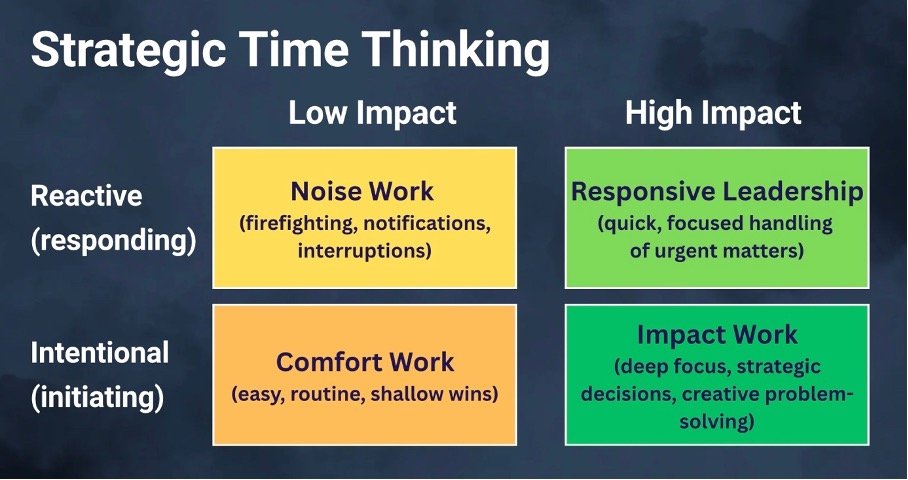
The difference between a busy leader and an effective one is not effort. It is where that effort is invested. While comfort work can still be intentional, it doesn’t move the dial like responsive and impactful work does.
If you look at the work you’ve done over the past week, how much of it is responsive and impactful versus noise and comfort?
5. The Calendar Cleanse
Most leaders say they need more time. What they often need is subtraction.
Set aside thirty minutes every week and look through your calendar to find out:
What can I cancel?
What can I delegate?
What can I redesign?
Removing what no longer serves your priorities creates space faster than any productivity tool. Generally, noise and comfort work should be delegated, and meetings with low value (not a lot of impact) and a high cost (as in require a lot of preparation hours or involve a lot of people) should be either cancelled or redesigned to justify their presence.
If you are attending meetings simply because “they’ve always been in my calendar” or you “just want to be seen” then you’re probably not using your time most effectively.
Leadership capacity grows when unnecessary commitments shrink.
6. The 3-3-3 Rule
Once space is created, it must be protected. Otherwise, it’ll just get filled with other busy tasks.
A simple rhythm can anchor intentional leadership:
Three hours of deep work per day.
Three key priorities per week.
Three major outcomes per month.
Deep work moves systems forward. Weekly priorities maintain focus. Monthly outcomes ensure progress.
It’s not easy to carve and guard this space. But in addition to ultimately saving you time, it also will ensure that you’re using it for what matters most.
Cal Newport writes,
“Clarity about what matters provides clarity about what does not.”
Without clarity, busyness expands. With clarity, focus strengthens.
Key Takeaways
Busyness is not proof of importance. Impact is.
A full calendar often hides unclear priorities.
Meetings must justify their cost in value and outcome.
Most leaders spend too much time in noise and comfort work.
Deep focused work is where real leadership value is created.
Subtraction creates freedom faster than addition.
Leadership shifts from being needed to creating meaningful outcomes.
The Noise/Impact work, Calendar Cleanse and 3-3-3 tools help you repriotize time effectively
If you remember only one thing, remember this:
Motion is easy. Impact is intentional. There is a powerful shift from believing you are important because you are in demand to understanding that you are important because you create meaningful outcomes.
*this content is inspired by Covey, S. R. (1989). The 7 Habits of Highly Effective People. Free Press.