
Why Pursuing Pleasure Will Never Bring You Joy

Why Pursuing Pleasure Will Never Bring You Joy

Imagine it: You are having a bite of your favorite mouthwatering dessert. Mine is a rich dark chocolate cookie cake, but maybe yours is something else. Whatever it is, imagine it fully: How it tastes, the texture, what it does to your taste buds, mood, and emotions. You love it, right?

So what you are experiencing in that moment as you savour it: is it pleasure, happiness, or joy?

Despite how trivial the example is, knowing how to distinguish between these three feelings will make the difference between a life filled with regrets and one that leaves you truly satisfied in the end.

Yes, how you relate to that simple dessert says everything about the kind of life you are living. Caught your interest? Keep reading.

Sometimes, the words pleasure, happiness, and joy are used interchangeably. We may think they all mean the same thing — a feeling of contentment or delight. But on closer examination, there are distinct differences between these three feelings, how we experience them, and from where they originate. Knowing the difference will change how well you understand yourself and how you spend your time. It will allow you to truly know what makes you feel good. 

Let's start with the lowest-hanging fruit: pleasure.

What Is Pleasure?

At its core, pleasure is about satisfying our needs and desires. It’s about doing something that feels good in the moment. Pleasure is often fleeting; it can come from external sources like food or activities like shopping or playing video games, to name a few. 

Pleasure is something that we crave, as it offers an immediate sense of gratification that can be found in the small moments and experiences of everyday life. It’s the feeling of satisfaction you get when you:

  • Take a bite of your favorite food (including that delicious dessert you just imagined)

  • Get a massage after a long day

  • Experience the taste explosion of a gourmet meal

  • Sink into the hot water of a bubble bath

  • Experience sensual touch

  • Spend money on material things you attach some meaning to (from small things like jewelry and flowers to huge things like cars, houses, and vacations)

The key defining feature of pleasure is that it is a physical sensation and it is fleeting; it doesn’t last forever, and often its duration is actually quite short, leaving us craving for more soon again.

Pleasure is dependent on external factors and is not a sustainable source of long-term emotional fulfillment. By its nature, it is over the moment it is over. As a result, the pursuit of pleasure alone can lead to an imbalanced and unfulfilling emotional life as we try to consume more and more of its "kick" but are always left feeling empty shortly thereafter.

When we stop being aware of how and why we pursue pleasures, they can become a field onto which we project deficiencies in other parts of our lives:

  • We are stressed, so we eat too much food.

  • We are angry, so we go out drinking.

  • We are lonely, so we consume online dating.

  • We are insecure, so we spend a lot of money on items that boost our confidence.

While pleasures in of themselves aren't bad or good, the constant pursuit of pleasures, in which we project onto them something else that is currently missing in our lives, is a recipe for addiction formation.

Understanding how pleasures fit into our lives is essential for maintaining a healthy relationship with them. And recognizing that pleasure is a temporary sensation can help us appreciate its presence without becoming overly reliant on it. 

Perhaps you are starting to get a sense of the positive and shadow sides of pleasure and why you need to know what makes you feel good. But before we unpack that some more, let's first understand how pleasure relates to happiness.

What Is Happiness?

We've all heard people either agree or disagree with the saying that "Money can buy you happiness." Well, with our understanding above of pleasure, perhaps a less controversial statement would be, "Money can buy you pleasure," which it certainly can. But can lots of pleasure lead to happiness, and if so, can money buy that too?

Happiness is an emotion that, while also often externally provoked, tends to last longer than pleasure. It is typically dependent on something else than just satisfying desire, such as achieving a goal, receiving recognition, or experiencing positive life events. We feel it when experiencing the positive outcomes of our efforts. It can also be in response to experiencing pleasure but rather as a thought about having had or experienced the pleasure.

For example, we may have felt pleasure when diving into the cold water of a lake on a hot day and derive happiness when thinking about and remembering that experience afterward.

Happiness is less about material acquisition and more about experiences or our thoughts on those experiences.

Happiness is a reaction to favorable circumstances and can be influenced by factors such as our relationships, personal achievements, and overall life satisfaction.

Examples of situations that may bring happiness include:

  • Having a home garden and growing your own food

  • Having a great conversation with a dear friend

  • Watching someone else's face gets lit up with excitement

  • Completing a physically challenging feat

  • Collaborating with a team to achieve a common goal

These events can create a sense of accomplishment and contentment, contributing to our overall happiness. Whereas pleasure tends to stimulate desire, happiness activates our values.

When we see and experience things in the world that align with our own view of what is good, we often feel happiness. Happiness, like pleasure, is also often linked to external factors and may not provide a constant source of emotional well-being. It comes and goes, just like any other emotion.

The role of happiness in our lives is significant, as it can contribute to a sense of pride and purpose. At the same time, by realizing that happiness is temporary, we can better manage our expectations around when we feel it and what to change when it fades (i.e., surround yourself with more people and activities that align with your inner values; more about this later).

So does that mean money can buy happiness? Well, if money can buy pleasure, and those pleasures align with your values, then indirectly perhaps money can. The issue is when people’s pursuit of pleasures do not actually align with their values. Short-term cravings are satisfied, but we are left still feeling empty and unsatisfied after they are over. So when money is spent on things that align with our values, it stands a chance at increasing happiness, otherwise, it most probably won’t.

But, What Is Joy?

Joy stands apart from pleasure and happiness as it originates from a different source. According to Brene Brown in Atlas of the Heart, "Joy is sudden, unexpected, short-lasting and high-intensity. Joy expands our thinking and attention, and it fills us with a sense of freedom and abandon." (Brown, 2021)

There is something innately spiritual, internal, and breathtaking about joy. Its origins lie in something that may remind us of universal values like beauty, truth, love, and connection.

When in the presence of such experiences, we often feel joy.

When we experience a moment of our highest, most complete sense of self, we feel joy.

When we meet someone else who feels deeply rooted in their own positive spiritedness, we call them joyful.

The connection to joy is found through our relationships, perspectives, and experiences and often transcends feelings of pleasure and happiness in its intensity and depth. 

Examples of circumstances that bring joy may include:

  • Appreciating the beauty and belonging that exist within a close-knit community

  • Witnessing the caretaking and love between two individuals

  • Stopping your car to take in a gorgeous sunset with all its colours in the sky

  • Feeling the beauty of life when the warmth of the sun caresses the softness of your skin

  • Being moved by the passion and determination of someone else to do good in the world

These experiences often create a profound sense of connection and meaning that contributes to a unique sense of joy. Unlike pleasure and happiness, if we understand how to look for and identify sources of joy, it can become a more consistent source of emotional well-being. 

For that, though, you need to know what makes you feel good. 

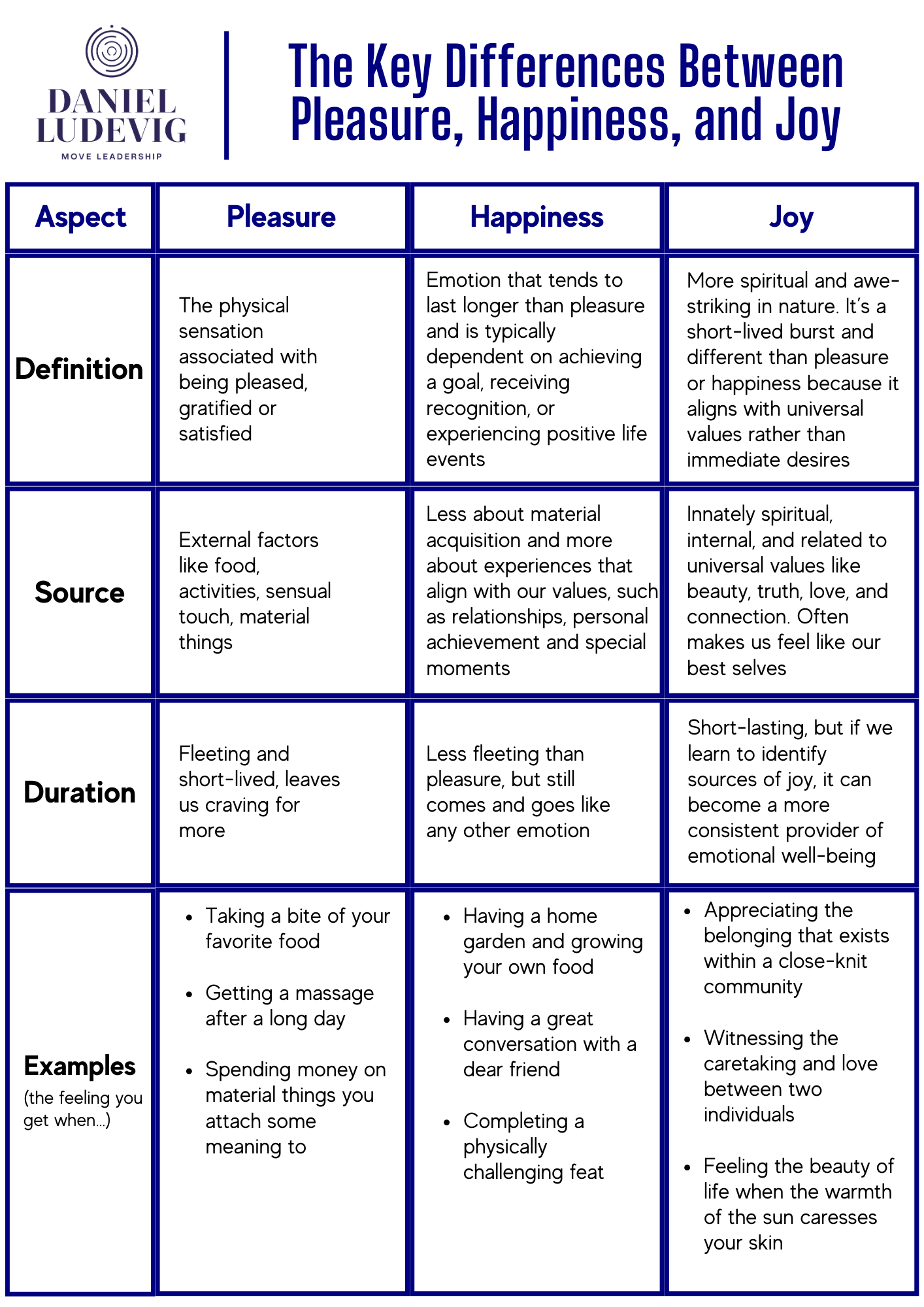
Here's a quick reference table outlining the key differences between pleasure, happiness, and joy, including examples of each feeling: 
The Consequences of Misunderstanding and Misidentifying Our Feelings

Understanding the distinctions between pleasure, happiness, and joy is essential for understanding our emotional landscape. Remember, these three words are distinct experiences with different origins and impacts on us. Failing to recognize the differences between them can lead to disappointment and depression, as well as unhealthy behaviors like self-medication or addiction.

For example, when we confuse pleasure with happiness, we may turn to substances or activities that provide pleasure instead of seeking authentic happiness in our lives. This type of deviation can lead to projection and, eventually, addiction.

Projection

Projection occurs when we make our feelings or emotions dependent on others or other things rather than acknowledging the underlying needs we have. This can lead to misunderstandings and strained relationships as we blame external factors for our lack of emotional fulfillment instead of examining our internal state. 

For example, let’s say that you have reasons to be unhappy in your life (caused by work or relationship issues, for example). As an antidote to your unhappiness you use pleasure-producing activities like sports or gambling to give yourself a hit of dopamine and are left feeling good in the moment you do them. With time, however you become convinced that, as long as you have those activities, you can be happy. Through this thinking, you are projecting your need for happiness onto activities that induce pleasure only. As soon as the pleasure is over you return to get another hit, so, more sports, more gambling. You keep thinking that each time it's giving you happiness but in fact you don’t feel any happier afterwards; it’s always short-lived. And so you return for more, and find yourself in a vicious cycle of obsessive working out or gambling, and disappointment that leads to returning for more. All the while, the other areas of your life that are actually causing you unhappiness continue to be a problem and drive you to further engage with this vicious cycle. That’s how projection works.

By understanding when we are outsourcing our wish for happiness to activities that bring us short-term pleasure, we can become aware of what we really lack and want. That awareness can help us look for how we can satisfy the underlying need in more sustainable ways. 

If we don’t, however, then the activities we project our happiness onto can become addictions. 

Addictions

Addiction arises when we rely excessively on short-term pleasures to fill an emotional void. We become dependent on the short-term fix they give us and feel we can no longer be happy without them. 

For instance, we might turn to excessive shopping, binge eating, or substance abuse as a means to experience pleasure and avoid dealing with the root causes of our unhappiness. When we do this for long enough, we become addicted to the feelings those experiences give us.

Recognizing the transient nature of pleasure and the external factors influencing happiness helps us break free from addictive patterns and seek more sustainable sources of emotional fulfillment. Of course, for that, you first need to know what makes you feel good — both in terms of pleasure and authentic happiness. One you do, you can then notice and detangle pleasure-providing activities with true sources of happiness.

Unraveling this misunderstanding takes intentional effort — it requires us to slow down and tune into how we're really feeling at any given moment so that we can understand what brings us true fulfilment. Read on to find out how you can do this. 

Strategies for Pursuing Experiences and Emotions in a Healthy Way

A. Recognize and appreciate pleasure, happiness, and joy for what they are

Cultivating a practice of gratitude is a powerful way to develop a healthy relationship with pleasure, happiness, and joy. This involves being present and attentive to our emotional experiences and acknowledging and savouring them without judgment.

By recognizing and appreciating the sensations of pleasure, happiness, and joy for what they are, we can derive genuine satisfaction from each without falling into the trap of constantly seeking more or confusing one for another.

So start noticing for yourself what each of these 3 feel like for you: the physical sensations in your body as well as the impact they have on your mind and mood when you experience pleasure, happiness and joy.

Doing so allows you to be more present to each as it’s happening. When you are more present to them, you can add in being grateful for each of these sensations as they occur. Gratitude for these sensations not only allows us to experience them more fully in the moment. It also helps us recognize their presence more often. Practicing gratitude increases our ability to notice moments in which the possibility for pleasure, happiness and/or joy exist.

This increased awareness and gratitude creates a powerful upward cycle. For example, we experience joy, are then grateful for the experience, and in turn experience more joy as a result of our appreciation for this moment. And unlike the pursuit of pleasure, when it comes to joy, the more, the better. More frequent experiences of joy are linked to increased well-being, life satisfaction, and fulfillment. 

B. Establish emotional boundaries

Another crucial aspect of maintaining a healthy emotional life is establishing emotional boundaries. This includes practicing self-care and prioritizing emotional well-being by setting limits. Doing so prevents emotional burnout and overindulgence. This means learning when to say "no" to protect our emotional health and well-being.

Often the boundaries we need to set are not only with others but sometimes also with ourselves. Realizing when our pursuit of pleasure is crossing the line into an unhealthy habit is an opportunity to put up a boundary between how and when we engage with that activity and dig into why we crave it in the first place. Remember, pleasures in of themselves are not a problem. It is only when we abuse or use them as a projection field that it then becomes an issue.

C. Align your pursuits with your values and true desires

In order to experience genuine joy and fulfillment, it's crucial to align our pursuits with our values and deepest needs. Reflect on what truly brings you happiness, joy, and fulfillment, and pursue activities and relationships that match your core values and aspirations.

This alignment allows us to cultivate a deep, enduring sense of emotional satisfaction that goes beyond fleeting pleasures or transient highs. Remember, pleasure is more physical and short-lived, happiness more linked to our values, and joy more linked to an awe-like moment of real satisfaction and connection to the life around us. With that in mind, know what makes you feel good and then align your actions accordingly. Take the time to identify for yourself which activates activate your most important personal values, and then fill your days and weeks with plenty of those, instead of compromising with too many pleasure-seeking ones.

Final Thoughts

Pleasure, happiness, and joy are three distinct experiences that have powerful impacts on our lives. As we strive to experience each of these in our day-to-day lives, it is important to recognize the differences between them and know what makes you feel good.

Too often, we mistake pleasure for happiness or joy and fail to appreciate the unique qualities of each. Ironically, this misunderstanding causes us to miss out on the full range of human experiences available to us, as a wonderful part of life is being able to enjoy pleasure, happiness, and joy. The key is to be aware and conscious of the sources and impact of each for us.

Take the time to learn about the distinctions between these three. Know what makes you feel good and how it shapes your needs and choices.

You might just find that not only will you enjoy the pleasures of that favorite dessert of yours more deeply, but that you are able to derive pleasure, happiness and joy from it as well.

References:

Verywell Mind - How Freud's Pleasure Principle Works - https://www.verywellmind.com/what-is-the-pleasure-principle-2795472

PositivePsychology.com - What Is Happiness and Why Is It Important? - https://positivepsychology.com/what-is-happiness/

Brown, B. (2021). Atlas of the Heart - https://brenebrown.com/book/atlas-of-the-heart/

Don’t forget to share this blog post with a friend and join my mailing list to stay updated!

Ready to discover genuine joy beyond fleeting pleasures? Follow me on Instagram and LinkedIn today for thought-provoking content and practical strategies to find lasting fulfillment. Let's embark on this journey toward true happiness together!

How to Drop the Mask and Start Living Authentically

How to Drop the Mask and Start Living Authentically

Have you ever played a role for so long that you forgot who you truly are? Maybe it's at work, trying to be a certain type of manager or colleague in order to succeed... Or with friends trying to fit in by pretending you're interested in something you're not... Or even with family by continuing to be our 16-year-old selves even though we've outgrown that person years ago. This is a familiar feeling for many people, often likened to wearing a mask. We adorn these masks early in our lives as we grapple to find our place—to find where we belong.

And yet, these masks are merely facades, disguises we wear, which over time, create a void between our true selves and the characters we play in our personal and professional lives. They may have served us at one point in time, but what happens when the mask just doesn't fit anymore?

In this blog, we will explore the journey of self-discovery and the transformative power when you drop the mask and reconnect with your authentic self.

The Masks We Wear: The Early Years

From childhood, we're taught to wear masks for compliance and conformity. Parents, teachers, and society encourage us to "fit in" and adjust our behavior to meet expectations. So, we put on masks to be accepted and feel a sense of belonging. We become the "people-pleaser," the "overachiever," the "class clown," or the "perfect son or daughter."

These masks often do serve us in our early years, helping us navigate the challenging waters of social life. In the workplace, they can help us get ahead, achieve our goals, and establish our place within the team. But as we grow older, these masks can begin to feel restrictive, heavy, and even suffocating.

However, there comes a time when we reach an awakening—a turning point in our lives. We start to question the authenticity of these masks that we have donned for so long. This transformative phase holds a power that has the ability to shape the rest of our lives.

The Awakening: The Turning Point

As we evolve in our personal and professional lives, we may find ourselves in a conflict or even crises with ourselves. The coping strategies and identities that once seemed to protect us now feel like burdens. We begin to question, "Who am I, really?" The realization dawns that what got us here today won’t necessarily get us to where we want to be tomorrow.

This happens at different times for each of us. And although it may start early for some—say, in the mid-20s—for most, it seems to start in the 30s and then continues well into the 40s and 50s. The experience of a mid-life crisis—often linked to the sense that who we've become is so different than who we thought or wanted to become—can be linked to years of mask-wearing.

It's at this point that we're presented with a choice. Do we continue to wear the mask, remaining stuck in an identity that no longer serves us? Or do we muster the courage to drop the mask, unlearn old behaviors, and start living authentically?

Dropping the Mask in Your Personal Life

When we choose to live authentically, we embark on a journey of self-discovery. We start to recognize and embrace who we really are, our values, our passions, and our strengths. We learn to express our emotions honestly, and we give ourselves permission to be vulnerable.

The beauty of living authentically in our personal lives is that it allows us to forge genuine connections with others. When we show up as our true selves, we invite others to do the same. This deepens our relationships and fosters a sense of true belonging, built not on pretenses but on genuine mutual acceptance.

Unmasking for Professional Success

In the workplace, living authentically means bringing our whole selves to work, not just the parts deemed "professional" or "acceptable." Authenticity at work can lead to increased job satisfaction, better performance, and stronger relationships with colleagues.

While it's not easy to start doing if you're coming out of years of mask-wearing, people who drop the mask and live authentically at work are not only happier but also more innovative. They are not afraid to voice their opinions, express their ideas, or advocate for their needs. They create and foster workplaces where diversity of thought is celebrated, and authenticity becomes the norm, not the exception.

5 Tools to Drop the Mask and Live Authentically

Let's take a look at these 5 empowering tools that can help you drop the mask and embrace authenticity.

1. Self-Awareness

Practice self-reflection and identify your values and beliefs. This is the number one step to showing up authentically. There is no way to be you if you don't know who you are.

Tool:

For 5 days straight, observe yourself as if you were observing someone else.

  • At the end of each day, write a list of everything that excited you, scared you, triggered you, and made you happy.

  • At the end of the week, identify your values and beliefs that link together the experiences you had. These values are the foundation of who you are and how you show up (or want to show up) in the world.

2. Communication

Speak up and share your opinions and feelings. Authenticity requires vulnerability. It's not always easy, but the result is that others deepen their connection with the real you.

Tool:

Giving feedback to others is a powerful way to start practicing authentic communication. To do so in a safe and productive way, make sure you hit on these points:

  • Situation: Where/when did something happen?

  • Behavior: What was the observed behavior you saw?

  • Impact: What was the impact the behavior had on you?

  • Request: What would you like the person to do differently next time?

Practicing giving this kind of feedback strengthens your confidence in using your voice, speaking up, and sharing what's important to you.

3. Uniqueness

Stop comparing yourself to others and focus on your own journey instead. Everyone's path is unique, so honor the one you are on.

Tool:

  • Make a list of the top 5-7 qualities that you possess, are proud of, and feel are unique to you. If you aren't sure of what they are, ask some close friends to share their perception of your top qualities.

  • Then, each morning, wake up and set an intention to really lean into one of those qualities for that day. Find opportunities for how you can bring those qualities to life and benefit from them.

  • Reflect at the end of the day on where it was easy and when it was hard to embody your qualities.

  • The more conscious you become of what makes you special, the more you can let those parts shine and guide you.

4. Boundaries

Set boundaries and say “no” to things that don't align with your values or priorities. This will help you stay true to yourself and avoid overstretching yourself to please others.

Tool:

Practice saying “no” at least once each day. It can be something small or large — it doesn't matter.

The point is to start building the skill to put up your boundaries. This is not selfish; it's responsible and necessary if you want to be able to show up fully in the world and not have others run all over you.

5. Acceptance

Embrace your imperfections and let go of the need for perfection. Accepting your flaws and mistakes is a key part of being authentically you.

Tool:

Notice once a day when your ambition for perfection is preventing you from moving forward. Then, practice finishing the task when it is only 80% complete. It can be a small or large task, like:

  • Sending an email,

  • Submitting a proposal, or

  • Publishing a post.

The point is to start realizing that everything is still okay even when it's not perfect and that your perfection is stopping you from making progress.

Final Thoughts - A Life Unmasked

The masks we wear may seem comforting at first, providing a shield from judgment and a semblance of belonging. However, they often prevent us from expressing our true selves and experiencing genuine connections. The turning point arrives when we realize that our masks, while once protective, are now barriers to our current and future growth and happiness.

Embracing authenticity and starting to drop the mask may seem daunting, but the rewards are well worth the journey. The authenticity we cultivate becomes our guide, leading us to a life of deeper meaning, fulfillment, and joy. After all, there's nothing more liberating than being truly, unapologetically, you.

References:

Cialdini, R. B., & Goldstein, N. J. (2004). Social influence: compliance and conformity. Annual review of psychology, 55, 591–621. https://doi.org/10.1146/annurev.psych.55.090902.142015

Hewlin, P. F., Karelaia, N., Kouchaki, M., & Sedikides, C. (2020). Authenticity at work: Its shapes, triggers, and consequences. Organizational Behavior and Human Decision Processes, 158, 80-82. https://doi.org/10.1016/j.obhdp.2020.01.010

Don’t forget to share this blog post with a friend and join my mailing list to stay updated!

Ready to drop the mask and start living authentically? Follow me on Instagram and LinkedIn today for insights, support, and inspiration on your journey towards authenticity and fulfillment.

You Can Manage Your Stress: Reacting to and Coping with Stress in Healthy Ways

You Can Manage Your Stress: Reacting to and Coping with Stress in Healthy Ways

Pandemics, recessions, and wars... breakups, deadlines, and traffic: Figuring out how to react and cope with stress when it strikes — whether it be huge or something small — can be hard. Stress is like a storm cloud on the horizon, always lurking and ready to unleash its fury. Every day, we’re faced with situations that test our ability to manage stress. 

But is all stress bad? And can we really manage the way it affects us? 

In this blog post, I’ll share with you everything you need to know about stress, how to deal with it, and even how to come out of it stronger, more positive, and balanced. After reading this and putting these tips into practice, you'll find that you can manage your stress!

Why Does Stress Management Matter?

Different factors can trigger stress for us, such as our work environment, family dynamics, financial situation, health condition, or our encounters with trauma-recalling events. These factors are called "stress triggers" or "stressors."

While we can’t always avoid or prevent these stressors, we can choose how we respond to them. That’s where stress management comes in. 

Stress management is a collection of methods and plans designed to help people cope better with stress in their lives. It involves identifying the specific sources of stress and taking proactive steps to minimize their effects before, during, and after they occur.

Stress management can also improve well-being and resilience. By managing our stress levels, we can perform better at work or school, improve our relationships with others, and enjoy life more.

How Stressed Are You?

Stress manifests itself in various ways for different people. The very first step to working on stress is to identify that you are stressed. Do you know how to spot the signs of stress for yourself? 

Take a look at the checklist below and tick off anything you have been feeling in the last week. Don’t worry about how often or strongly you felt them. If you've experienced it, it gets a tick.

Now, count how many items you’ve checked on the list. Once you have your number, refer to the chart below to identify your stress level:

(Adapted from Baylor University’s Stress Symptom’s Checklist. Please note that like any self-assessment, this isn't "The Truth." Rather, it's a starting point to then get into reflection with yourself on this topic). 

Remember, the first step to managing stress is to be aware of when we are stressed. So don't beat yourself up if your results indicate a higher stress level than you’d hoped for. Now that you're aware of it and the physical, behaviour, emotional, and cognitive ways it manifests, you can start doing something about it.

But Stress Isn’t Always Bad

Before we try to eliminate stress entirely, it's important to mention that everyone experiences stress to some degree, and not all stress is bad. In fact, stress can be healthy in some situations as long as it’s not overwhelming or chronic. It can motivate us to take action, improve our focus and creativity, and boost our immune system and resilience. 

This type of "healthy" stress is a normal and necessary part of being alive. Without it, we'd become bored out of our minds and wouldn't develop the necessary strength to fight off diseases and dangerous situations.

Yet, while stress can be beneficial in some situations, it can also have negative effects when the stress level gets too high and we don’t handle it well. When stress exceeds the amount that puts us into the "Good Zone," it can push us into the "Terror Zone" (see my blog post on this topic around energy management).

When stress moves us into unsustainable territory, many people try coping with activities like drinking, gambling, working, having sex, and eating to distract or numb themselves. These activities aren’t bad in themselves, but they can become harmful if we rely on them too much or use them to avoid our problems. 

The key is to find healthy ways to manage our stress rather than resorting to projecting our stress onto others, avoiding facing our stress, or distracting ourselves to avoid dealing with it.

What Are Healthy Ways to Manage Stress?

If you want to handle stress better and become more resilient in life, it's helpful to break down the many points in time when you can work on it. While knowing how to manage stress in the moment is important, it's just one part of the puzzle. What you do before and after stressful events is as, if not more important than how you deal with it right when it happens. You Can Manage Your Stress!

Before Stress (Prevention)

A great way to manage stress is to prevent it from happening or lessen its intensity on us. While you can’t control the outside world, you do have lots of control over how things affect you. Here are some effective strategies you can use to help prevent or reduce stress before it starts:

1. Identify Your Sources of Stress

The first step is to recognize what causes you stress. These stress instigators are your triggers.

  • Is it your work? 

  • Your relationships? 

  • Your finances? 

  • Your health? 

  • Your expectations? 

Look back at the last 1-2 weeks and write down a list of all the things that triggered you and caused you stress. Start to notice if there are some patterns that link various triggers together. What is causing you to get stressed or triggered by these events? 

Most people are only really triggered by 3 or 4 types of events — and these are situations that keep repeating themselves in various forms — so knowing what they are will help you start working on them. 

We are often triggered by events that clash with something we value: be it freedom, fairness, calmness, authenticity, etc. So identify your triggers and then uncover and cluster the root causes (i.e., the values that are being stepped on when that trigger happens).

Just knowing these patterns already gives you an advantage in starting to predict and work with triggers before and when they happen.

2. Plan Your Response Ahead

Once you know your triggers and what types of situations are likely to activate them, you can then work on your response to that trigger in advance of it happening. 

For example, if there's always someone at work that triggers you, you know there will be situations in the future where they will trigger you again. So rather than being caught off-guard each time it happens, prepare for it by visualizing what will happen in advance. 

Visualisation works best when you have a moment to yourself and are calm and grounded. Here’s how to do it:

1st Step - Visualize the trigger

Once you've carved out a moment for yourself, start by imagining the trigger: where, when, who else is around, and as many details as you can. The more you visualise it, the better you can work with it. 

2nd Step - Visualize your response

Then, as a second step, identify for yourself how you would like to manage this situation if you had access to your full resourcefulness, creativity, and empathy in the moment when it happens. 

This is an important step because in the moment when we are actually triggered, it's impossible for us to access this rational part of our brains. The trigger flairs up our more primitive fight, flight, and freeze reactions, and we are left feeling helpless to better responses. But since you are now visualizing this event during a moment when you are grounded and calm, you may find that there are more response options available to you than you realized. 

3rd Step - Choose a response for next time

As a third and final step, make a list of all (desirable) response options you could have, choose the one that feels best, and then plan to practice that new response the next time the situation happens. 

Be kind to yourself; you may not execute on your plan perfectly the first time (the situation is after all a trigger for you). But with time, you'll find that each time the situation happens, it's a chance for you to improve your desired response to it. 

Do this type of work with each trigger that is meaningful to you, and you'll find that the stressfulness of the situation will loosen its grip on you.

3. Set Boundaries 

Sometimes, we take on too much or say yes when we want to say no. This can lead to feeling overwhelmed, resentful, and eventually burnout. In this state, even small things that don't usually trigger us can lead to huge emotional reactivity. 

To prevent this kind of stress, learn how to set boundaries with others and with yourself. Have the courage to say "no" when you need to say "no" (see my blog on how to say no for a deep dive into this topic). Delegate tasks when possible. Ask for help when needed. 

Setting yourself up so that you only take on your plate as much as you can handle (professionally, personally, socially, or physically) is a huge part of being less triggered and stressed by events happening around us.

4. Create a health-supportive system

Of course, it goes without saying that there are some other basic habits that help with maintaining a healthy physical and mental state: 

A. Eat Well-Balanced Meals

Eating a balanced diet that provides you with enough nutrients and energy can help you cope with stress better and avoid stressful illnesses. If you're not sure what a balanced diet means, think whole, unprocessed foods, maximising as many different colours of food types as possible. Consult a nutritionist for more details on this. 

B. Get Enough Sleep

It's different for each of us, but most studies suggest a minimum of 7 hours a night.

C. Exercise Regularly

Being physically active can help you reduce stress by releasing endorphins (the feel-good hormones) in your brain, improving your mood and self-esteem, enhancing your physical health and appearance, and providing you with a positive outlet for your emotions. 

Find an activity that you like, maybe with a group if that helps keep up your motivation, and set goals and milestones that you then celebrate with healthy rewards.

D. Good Social Circle of Support

Having supportive people in your life who care about you and understand you is another healthy way to prevent stress before it happens. When you know you are grounded in a strong community, it can make some stressful situations feel less threatening. Some tips for building a good social circle of support include:

  • Reaching out to people who share your interests or values

  • Maintaining regular contact with your friends and family and making sure you keep a diverse mix of people who inspire you, have varied experiences from you, are willing to lend a helping hand when you need it, and see the greatness in you

  • Expressing gratitude and appreciation for their support

  • Being supportive of them in return (such as offering help or encouragement when they need it)

E. Know Your Purpose and Live By It

Knowing your purpose means having a clear sense of what matters to you and what gives meaning to your life. It can help you manage stress better by motivating you to:

  • Pursue your goals and passions

  • Inspiring you to overcome challenges and difficulties

  • Aligning your actions with your beliefs and values

  • Providing you with a sense of direction and fulfillment

  • Giving you the perspective to realize that whatever is stressing you isn't worth the attention you are giving it

This purpose doesn't need to be a "I want to change the world" kind of statement. Your purpose might be just making people around you smile. Or providing a safe home for your kids. Or just being able to learn about yourself. 

Find that purpose, and you'll find that you become more resilient to ignoring distractions that don't align with it. Make time to fill your schedule with activities and people that nourish it, and cut out those who don't. 

5. Work on Your Mindset

A. Let Go of Perfectionism (see my blog about perfectionism) to understand what a huge difference this can make in the ways we trigger ourselves. 

B. Practice Assertiveness and Speak Kindly to Yourself

This includes listing out the qualities that make you unique, transforming the way you see them so that you really view them as superpowers, and then finding situations where you can use those superpowers to gain balance, groundedness, and perspective. 

C. Focus on the Here and Now by Being Mindful

Part of the reason that triggers have such a strong impact on us is that they are able to grab the attention of our mind and completely focus it on one stressful aspect of a situation. However, mindfulness practices allow us to strengthen our ability to see when this awareness-hijack happens. Once you’re aware of it happening, you can bring the attention of your mind back to something more grounded and useful. 

So by embedding a mindfulness practice, you are literally strengthening your mind so that it doesn't get triggered as easily. And when you do get triggered, mindfulness practice supports you in realizing you are triggered more quickly, allowing you to more quickly take back control. 

During Stress (Intervention)

Sometimes, we can’t avoid or prevent stressful situations. They just happen unexpectedly or unavoidably. In these cases, we need strategies that can help us cope with in the moment stress. You Can Manage Your Stress when you:

1. Breathe Deeply

One of the simplest and easiest yet most effective ways to cope with stress while it happens is to breathe deeply from your diaphragm (the muscle below your lungs). Deep breathing (think longer, slower exhales in particular) calms your nervous system and lowers your heart rate and blood pressure. It also sends a signal to your brain that everything is "OK," which further calms your entire system down. Try box breathing: 4 counts inhale, 4 counts exhale, 4 counts inhale, 4 counts exhale while you imagine yourself moving up, across, down and across the sides of a box.

2. Use Positive Affirmations

Positive affirmations are statements that reinforce your confidence, ability, and worthiness. For example, if you’re feeling stressed about a presentation at work, you can say to yourself:

  • "I am prepared"

  • "I am capable"

  • "I am confident"

Positive affirmations can also help you challenge negative thoughts and vicious self-talk cycles in the moment when you are stressed, allowing you to keep your perspective and stay balanced within yourself and your abilities.

3. Shift Your Perspective

Often what stresses us in the moment is an inability to see things from a larger view. We feel trapped, helpless, and without the ability to change things. 

Asking yourself these questions in the moment you are stressed can allow for a perspective shift that helps you return to a more grounded and balanced state:

A: How might the other person in this situation describe what's happening?

B: How will I likely view this situation in 5 minutes/days/weeks/months?

C: What would a best friend advise me to do in this situation?

D: If this situation was meant to teach me something important, what would that be?

E: What is still good in my life, even while this situation is happening?

4. Seek Social Support

Seek social support from people who care about you, such as friends, family members, or colleagues. Social support can help you:

  • Feel less alone

  • Get different perspectives

  • Receive advice

  • Vent your emotions

You don't need to hold everything you're dealing with all by yourself. Reach out in the moment you feel stressed and benefit from one of the most fundamental parts of being human: connection and belonging with others. 

5. Practice Skills to Manage Difficult Conversations

The basis for how to prevent difficult conversations from escalating is to understand the ways in which we add fuel to the fire when communicating. Non-violent communication is one methodology for improving this and has a lot to do with owning your own experience and emotions, speaking from the "I" rather than "YOU" voice, and not using accusatory or blaming/assumptive language. This approach encourages active listening and empathetic understanding of the other person's perspective.

Non-violent communication is based on four key components:

  • Sharing concrete observations

  • Sharing your own feelings

  • Expressing your needs

  • Making clear requests

The goal is to find mutually beneficial solutions to problems and build positive relationships. You can use it in various settings, including personal relationships, work environments, and community situations. While non-violent communication requires practice and patience to master, it can be a powerful tool for improving communication and reducing conflict.

After Stress (Recovery)

After a stressful situation is over, we need strategies that can help us recover from stress and restore our balance. You Can Manage Your Stress when you:

1. Write It Down

Writing can help you process your emotions, gain new insights, and release tension. You can also write down what you learned from the situation and what you can do differently next time when such a trigger appears again.

2. Take a Break

Take a breather from your usual routine and do something that relaxes you or makes you happy. You could:

  • Explore a scenic trail in nature and breathe in the fresh air

  • Listen to your favorite music and sing along or dance to the rhythm

  • Watch a hilarious comedy and laugh out loud

  • Read an engaging book and immerse yourself in a different world

  • Play with your adorable pet and cuddle with them

Taking a break can help you give some time away from stress, allowing you to recharge your energy and then revisit the situation with a different view on it.

3. Create Something

Try creating something that expresses your feelings or interests. You could try:

  • Drawing, painting, or sculpting something that represents your emotions

  • Keeping a bullet journal, a diary, or a gratitude log to let your inner experience flow out onto the page

  • Cooking new recipes, experimenting with favorite dishes, or indulging in some artistic baking to spark your creative juices

  • Learning to dance salsa, tango, hip hop, or ballet to release any physical and emotional stress you are holding

Creating something can help you process your stress, express your feelings, boost your self-esteem, and stimulate your brain.

4. Learn About Yourself

Like I said earlier, stress isn’t always bad; it can also be an opportunity to learn about yourself and what's important to you. Ask yourself these questions:

  • What triggered my stress? 

  • How did I react to my stress? 

  • What did I learn from my stress? 

  • What can I do differently next time? 

Final Thoughts

Stress management is not about eliminating stress from our lives but about finding healthy ways to deal with it. While you may not be able to control stressful situations from happening, you can control your response to them. By understanding how stress affects you and learning how to react, cope with, and bounce back from it, you can live better, feel better, do better, and get more out of your life. 

Ultimately, stress is a natural part of being human, but that doesn't mean that it has to take you down each time it hits you… You Can Manage Your Stress. 

Now, all you need to do is build in a routine of healthy habits to support you in doing so. 

References:

Syracuse University School of Education - Self-Care https://soe.syr.edu/departments/academic/counseling-human-services/modules/self-care/

Baylor University - Stress Symptom Checklist

https://www.baylor.edu/content/services/document.php/183434.pdf

Stanford Medicine - Study Explains How Stress Can Boost Immune System

https://med.stanford.edu/news/all-news/2012/06/study-explains-how-stress-can-boost-immune-system.html

Sleep Foundation - How Much Sleep Do We Really Need? https://www.sleepfoundation.org/how-sleep-works/how-much-sleep-do-we-really-need

Model Thinkers - Nonviolent Communication https://modelthinkers.com/mental-model/nonviolent-communication

Don’t forget to share this blog post with a friend and join my mailing list to stay updated!

Ready to take control of your stress levels and enhance your well-being? Follow me on Instagram and LinkedIn today for insightful tips, tools, and resources to help you manage stress and thrive in every aspect of your life. Let's conquer stress together!

How to Control Your Trigger Reaction Instead of It Controlling You

How to Control Your Trigger Reaction Instead of It Controlling You

Every day, we come across things that really get under our skin. It could be a cryptic "We should talk..." message, someone cutting us off in traffic, or even just some criticism. These incidents are called triggers, and they happen to all of us. But guess what? Learning about and managing your reaction to these triggers can be your greatest ticket to personal growth. 

In this blog post, we'll explore triggers - what they are, why they produce such a big reaction in us, how they affect us, and how to handle them on the spot. Plus, we'll look at addressing their deeper causes for lasting change. So let‘s dive in and begin learning how you control what stresses you

The Triggering Experience

Triggers are those incidents when something seemingly insignificant sets off an intense emotional reaction within us. Even in the cases where the incident is not so insignificant, if you later notice that your reaction to the situation might have been out of proportion with what was actually happening, then you were triggered. These triggers evoke a cascade of emotions, thoughts, and physical sensations that can be overwhelming at times.

Let’s take a common example: Imagine being stuck in traffic and someone dangerously cuts in front of you without signaling. Your initial reaction might be a flash of anger, your heart starts to race, and perhaps even a few choice words fly out of your mouth.

Or picture sitting at your desk, and an email notification from your boss pops up with the subject line, "Come to my office." Instantly, your palms might start to sweat and your thoughts spiral into a whirlwind of worry. This is you being triggered (and if neither of these examples trigger you, then just think of one that produces a similar type of immediate reaction in you, and that’s an example of your trigger)..

Your reaction to triggers are the immediate, visceral responses that accompany them after they happen, making them hard to ignore. In order to be able to control what stresses you, the first step requires your awareness that these reactions are even happening.

The Neuroscience Behind Triggers

To understand triggers and why they cause such reactions in us, we need to peek into the intricate workings of our brains, which have a built-in alarm system called the amygdala. This tiny, almond-shaped structure is responsible for triggering our fight-or-flight response when it perceives a threat and leads to the phenomenon known as the "amygdala hijack." 

While you probably have already heard of the fight, flight, and freeze reactions, there are some other reactions that can also happen: 

Freak-out, when you become irrational and start frantically engaging in tasks that have nothing to do with the trigger; tending, when you start caring for others instead of paying attention to what you need; and befriending, when you get closer to the person who is triggering you in the hopes that that will keep you safer than being their enemy.

Triggers can activate any of these reactions within us, even when the threat isn't physical but rather emotional or psychological. Understanding this neural process helps us grasp why triggers can be so intense and challenging to control. 

In short, when we perceive situations as threatening our safety, whether physical, social, professional, or relational, we are likely to find ourselves in the grips of a strong trigger reaction. While we don’t all get triggered by the same things, we all do have things that trigger us. And while reacting to them is wired into our survival biology, experiencing them in our everyday lives can leave us breathless and overwhelmed in their powerful embrace.

This brings us to the question of how triggers affect our day-to-day decision-making and overall well-being. 

When we're triggered, our decision-making abilities take a hit. Empathy dwindles, perspective narrows, and creativity stalls. Essentially, we're not our best selves when our triggers are activated. The amygdala hijacks the parts of our brains responsible for rational, empathic, and creative thought, and as these parts go offline, we are literally limited to only the survival-based options that remain. 

When this happens, our bodies are the first to react—heart racing, sweating, accelerated breathing, muscle tension—and this is immediately followed by a slew of emotions such as panic, despair, anger, sadness, frustration and fear. 

Our thoughts follow suit, thinking things like:

  • Why is this happening to me?

  • I’m not good enough.

  • They hate me.

  • I‘m getting fired.

  • How dare you?

  • I need to get out of here!

  • You‘re so selfish!

  • There‘s nothing I can do.

While this amygdala-hijack model is an overly simplified explanation of how the brain works, it can provide us with an easy-to-understand picture of what’s taking place in our brains in the moment we get triggered. This helps explain why it can be so difficult to self-regulate and calm ourselves down in these moments.

However, not all hope is lost. With the right tools, you control what stresses you, so let’s switch gears and focus on practical things you can do right when you feel triggered to change your state.

Coping in the Moment vs. Deeper Healing: Short-term Interventions

Fortunately, there are ways to cope when triggers strike. Simple techniques like mindful breathing and grounding exercises can help you regain control of your emotions and reactions. These strategies are essential in the heat of the moment, but they're only the first step. Check these out, but make sure to also read the next section that introduces how to heal your triggers at the true source from which they come.

1. Use Your Breath

Having a variety of breathing techniques in your toolbox is essential, as they are the fastest way to signal your brain to pause and reduce panic. Here's a visual guide on one of my favorites, called the 3 Breaths:

2. Take an Intentional Pause to Respond

Develop the habit of taking a momentary pause after a trigger occurs and before reacting. This pause allows for self-reflection, increased self-awareness, and the opportunity to choose a more thoughtful response instead of an impulsive reaction. 

The key behavior in this pause is for you to notice that while your reaction is intense, you can still be an observer of it. And if you are able to observe it, then it is not entirely you. Your observing self is your pure you, and from this place, you can choose a different response. 

ETC or "Emotion, Truth, Choice" is a tool that guides you through 3 questions to deescalate your triggered mind, connect you with helpful thoughts, and provide you with new choices. 

Remember to take a deep breath before steps 2 and 3, calming your amygdala-hijacked brain as you do so each time. Through that, you gain access to more perspectives and options.

3. Use Your Body

Reconnecting with the body is important for grounding and managing triggers and stress effectively. Let's start with an exercise that combines breath with the additional element of some minimal body movement.

Abdominal Breathing

  1. Place one hand on your stomach and one hand on your chest.

  2. Deeply inhale through your nose and feel your stomach rise.

  3. Slowly exhale through your mouth and feel your stomach fall.

  4. Repeat several times. This promotes relaxation and calm by drawing attention to the quality of your breathing movement.

Visualization

Visualization exercises help enhance the effectiveness of breathing techniques by drawing on the power of your mind. They can help deepen the connection with the breath, allowing for a more profound experience of relaxation, focus, and mental clarity.

Height Visualization

  1. Close your eyes and imagine your body from head to toe. 

  2. Feel the length of your entire body as you hold your attention from just below your feet to right above your head.

Width Visualization

  1. Continue now by bringing your awareness to the left side of your body. 

  2. Stretch your attention slightly beyond the left side of each body part, including your legs, arms, torso, and face. 

  3. While still holding some attention on the left, shift your focus to the right side and repeat the process, allowing yourself to fully feel the width of your body.

Depth Visualization

  1. Finally, visualize the front of your body, including your legs, stomach, chest, and face.

  2. Extend your attention just slightly beyond the surface. 

  3. While holding attention on the front, shift your focus to the back of your body, encompassing your legs, bum, back, arms, neck, and head. 

  4. Notice the full depth of your body as you keep yourself connected from front to back.

All of these techniques are like quick fixes, helping us regain our composure and navigate through challenging situations in the moment they happen. However, these strategies are just like a bandaid you'd apply to a wound. They provide immediate relief and prevent further damage, but they're not the ultimate solution. 

If you truly want to manage your triggers in a sustainable way, it's time to dig deeper into their roots.

Triggers Are Like Wounds: Long-Term Healing Approach

While the techniques above help to down-regulate your system in the heat of the moment, you may still be wondering why these incidents are triggering you in the first place, and why they keep coming back. After all, not all triggers create the same reaction in everyone.

I may be triggered by a long line at checkout, whereas you may find it totally fine; you may be triggered by someone interrupting you when you’re speaking, and it doesn’t bother me at all. To understand your specific trigger reactions, you need to look into your past. 

Consider triggers like wounds from your younger self. These wounds often have their roots in earlier life experiences, such as traumas from our past. These experiences create emotional wounds that may remain dormant until something triggers them. 

Any situation that you experience in which you are left feeling unable to protect yourself—whether emotionally or physically—can result in a wound. Especially as children, when we are often dependent on others for our safety, these experiences can leave us afraid of getting hurt again should we encounter them. So we develop a reaction to them that attempts to keep us safe. 

These traumas are not only limited to what I call big-T Traumas (such as experiencing physical or mental abuse, violence, harm, etc). They also include small-T traumas such as any daily event that hurts us and doesn’t get resolved properly. Being verbally bullied in school, having a parent leave you waiting when you thought they would pick you up, or losing a pet can all be small-T traumas that still leave an unhealed wound in our lives. As we grow older, we get reactive and protective anytime we encounter a situation that touches or activates that wound.

The reaction may involve getting aggressive, trying to hide, creating distance, or any number of other behaviors that try to keep us safe. As we get older and repeat these behaviors over and over again, whenever we encounter anything that reminds us of the original trauma, these reactions become our our go-to reaction. They are like a scab over that wound that becomes rigid, hard, and inflexible. 

As adults, while the triggers may no longer actually be harmful to us, if our amygdala senses them as threats then we are cast back into the same patterns of protective behavior that emerged when we first encountered those triggers.

It’s no wonder that we sometimes hear people say:

"Stop being such a baby," or "You’re acting like such a child," when someone’s reaction to a situation as an adult seems out of proportion with the actual circumstances they are in. 

In those moments, the person triggered literally is resorting back to a protection mode that was (wisely) formed at a time when they truly did feel vulnerable to danger. These protective mechanisms were like armour that safeguarded us from anxiety, fear, and danger during those difficult times. 

The problem is that these same behaviors that may have kept us safe then are preventing us from being able to live free and fuller lives today as adults.

More importantly, these emotional wounds won't heal by themselves. They linger and continue to cause pain until you take steps to address them. Delving into the root causes of triggers involves understanding where they come from and why they have such a powerful hold over us.

This entails revisiting the source of our wounds and understanding the protective mechanisms we developed in response to past challenges.

Understanding and Honoring the Initial Trauma

When it comes to dealing with triggers, it's important to think about how our mind's defenses, or protection mechanisms, come into play. These defenses affect how we react when faced with difficult emotions or situations. By understanding this connection, we can learn more about our reactions and, in turn, grow as individuals. 

Honoring and understanding these protection mechanisms is a crucial step in becoming more self-aware and fostering your personal development. 

Below is a table that presents protection mechanisms along with their descriptions, what they may have been initially protecting, and real-life examples where they could show up.

The next crucial phase is to question the assumptions that underlie these protection mechanisms. Life is dynamic, and circumstances change. The assumptions formed back then, as valid as they once were, may no longer be true if put up against the reality of your experiences today. 

So, it's important to ask whether the assumptions formed when you were triggered are still valid now. 

  1. Go through and make a list of assumptions that are present behind each of your reactions to triggers. 

  2. Then, check whether the assumptions are still 100% true. 

  3. See if you can find examples where the truth of each assumption may be more flexible than you previously thought. 

  4. If you‘re not sure, create some experiments with the intention of trying to disprove some of your assumptions. You can do this by trying out some new behaviors and seeing if the outcome you were worried would happen when facing a trigger with some new behaviors actually does occur or if something else happens instead.

  5. Go back and review your assumptions and see if they start to change. If your assumptions and underlying beliefs change, your behaviors will follow.

By challenging and changing these assumptions, we enable our protection mechanisms to adapt. Over time, our nervous system becomes less reactive to the same triggers because it recognizes that they no longer pose a threat. 

This is the longer-term solution, leading to real healing and growth. It‘s not easy work. In fact, it‘s probably some of the most difficult. But those who embark on this journey of self-discovery are led down the road of true transformation. 

Seeking the help of a therapist or trusted coach can also be effective. I've also gone deep into 'triggers' on my 'You Are What You Think' podcast. If you want to dig even further, you can listen to the 'Your Triggers Are Your Friends!' episode on Spotify and Apple Podcasts.

Final Thoughts

Triggers are inevitable in the journey of life. They can either unravel us or become stepping stones to personal growth. You control what stresses you. By understanding the triggering experience, recognizing the neuroscience behind it, and using coping strategies in the moment, you can regain control. 

However, to truly master your reaction to triggers, you must take the path of self-discovery and healing, understand your protection mechanisms, and challenge the assumptions that drive them. 

This journey, though challenging, leads to greater self-awareness, personal growth, and a more peaceful existence. So embrace the power to overcome your triggers, and you'll unlock the most authentic version of yourself.

References:

Cleveland Clinic - Amygdala - https://my.clevelandclinic.org/health/body/24894-amygdala

Bailey R., Pico J. Defense Mechanisms. [Updated 2023 May 22]. StatPearls Publishing; 2023 Jan-. https://www.ncbi.nlm.nih.gov/books/NBK559106/

Don’t forget to share this blog post with a friend and join my mailing list to stay updated!

Explore now to gain mastery over your reactions! Follow me on Instagram and LinkedIn today.

Why Your Perfectionism Is Stopping You from Improving

Why Your Perfectionism Is Stopping You from Improving

"You are enough."

Do you believe this? It's a simple phrase tossed around in self-help communities but is actually incredibly hard to truly believe in and live by. And what's more, the opposite of this is often praised in movies, popular culture, and education with the encouragement and celebration of perfectionism: Looks of admiration when a colleague says they had to pull an all-nighter to finish the project; silent nods of approval at the stay-at-home parent who always has the house tidy, dinner ready, and kids in bed while also managing to stay fit, healthy, and social….

Always improving, always striving, always being the best at this and that: it's a seductive narrative that can easily convince us that if we only reach or become XYZ, we will then finally be happy, successful, and satisfied. Unfortunately, not only will being perfect acquire you none of those things, but the path to perfection can even lead you to depression and disastrous failure, all while missing real opportunities for self-improvement along the way.

In this post, I'll break down the manipulative appeal of perfectionism and explain how adopting a growth mindset can help you move beyond. By doing so, you’ll be embracing your true self and a more fulfilling, productive, and balanced life.

The Concept of "You Are Enough"

Let's get one thing straight: believing you are enough is not a get-out-of-jail-free card for self-improvement and growth. It's not an excuse to stop working on yourself, developing your skills, or becoming a better friend, mother, son, or partner. The idea of believing that you are enough is about basic human rights and values: you are worthy of love, respect, kindness, and attention, no matter what.

You are enough—just the way you are—to deserve all of those things. Your status, education, wealth, clothing, skills, and fame do not entitle you to these things; you (and everyone else) have a right to them by the sheer fact that you are human. You are enough. There's nothing more you need to know, do, or have.

As you read this the above paragraph, what do you find yourself thinking? Do you believe it to be true? Or is there some small voice in your head that is saying something to the effect of, "Umm, actually... no, you're not."

We all have these voices. This unhelpful, negative, and sometimes all-out destructive self-talk is what I call saboteurs. And of all the self-talk saboteurs that humans carry around inside their heads, one of the most common villains is the "You are not enough" voice:

  • You are not good enough.

  • You are not smart enough.

  • You are not pretty enough.

  • You are not successful enough.

  • You are not funny enough.

  • You are not athletic enough.

Sounding familiar? I myself am in intimate regular conversations with the 2nd, 3rd, 4th, and 5th voices above, among many others.

So many of us tend to struggle with self-doubt, and we each have our way of navigating it and trying to deal with it. Some of our strategies are healthier than others. Obsessions, addictions, distractions... there are so many ways we compensate for not feeling good about ourselves.

Perfectionism is one such strategy, and of the many that are out there, it happens to be a particularly sneaky one because its associated behaviours are often publicly applauded.

So What Is Perfectionism?

There's no better summary that I've seen describing how perfectionism works than this excerpt from Brene Brown's book, "Dare to Lead." In it, she writes:

"Let's start with what perfectionism is not:

Perfectionism is not the same thing as striving for excellence. Perfectionism is not about healthy achievement and growth. Perfectionism is a defensive move.

Perfectionism is not the self-protection we think it is. It is a twenty-ton shield that we lug around, thinking it will protect us, when in fact, it's the thing that's really preventing us from being seen.

Perfectionism is not self-improvement. Perfection is, at its core, about trying to earn approval. Most perfectionists grew up being praised for achievement and performance (grades, manners, rule-following, people-pleasing, appearance, sports). Somewhere along the way, they adopted this dangerous and debilitating belief system: 'I am what I accomplish and how well I accomplish it. Please. Perform. Perfect. Prove.' Healthy striving is self-focused: 'How can I improve?' Perfectionism is other-focused: 'What will people think?' Perfectionism is a hustle.

Perfectionism is not the key to success. In fact, research shows that perfectionism hampers achievement. Perfectionism is correlated with depression, anxiety, addiction, life paralysis, or missed opportunities. The fear of failing, making mistakes, not meeting people's expectations, and being criticised keeps you outside the arena where healthy competition and striving unfold.

Last, perfectionism is not a way to avoid shame. Perfectionism is a function of shame." (Brown, 2018)

Ok! If that is not a slap in the face of all the validating voices encouraging your perfectionism, I don't know what is. And if this is the first time you are hearing perfectionism described this way, and it's feeling like a blow to your head, take a deep breath. It's ok. You are not alone.

But brace yourself, because to hammer the final nail into the perfectionism coffin, here's how Brene goes on to define it:

"Perfectionism is a self-destructive and addictive belief system that fuels this primary thought: 'If I look perfect and do everything perfectly, I can avoid or minimise the painful feelings of blame, judgment, and shame.'

Perfectionism is self-destructive simply because perfection doesn't exist. It's an unattainable goal. Perfectionism is more about perception than internal motivation, and there is no way to control perception, no matter how much time and energy we spend trying.

Perfectionism is addictive because when we invariably do experience shame, judgment, and blame, we often believe it's because we weren't perfect enough. Rather than questioning the faulty logic of perfectionism, we become even more entrenched in our quest to look and do everything just right.

Perfectionism actually sets us up to feel shame, judgment, and blame, which then leads to even more shame and self-blame: 'It's my fault. I'm feeling this way because I'm not good enough.'" (Brown, 2018)

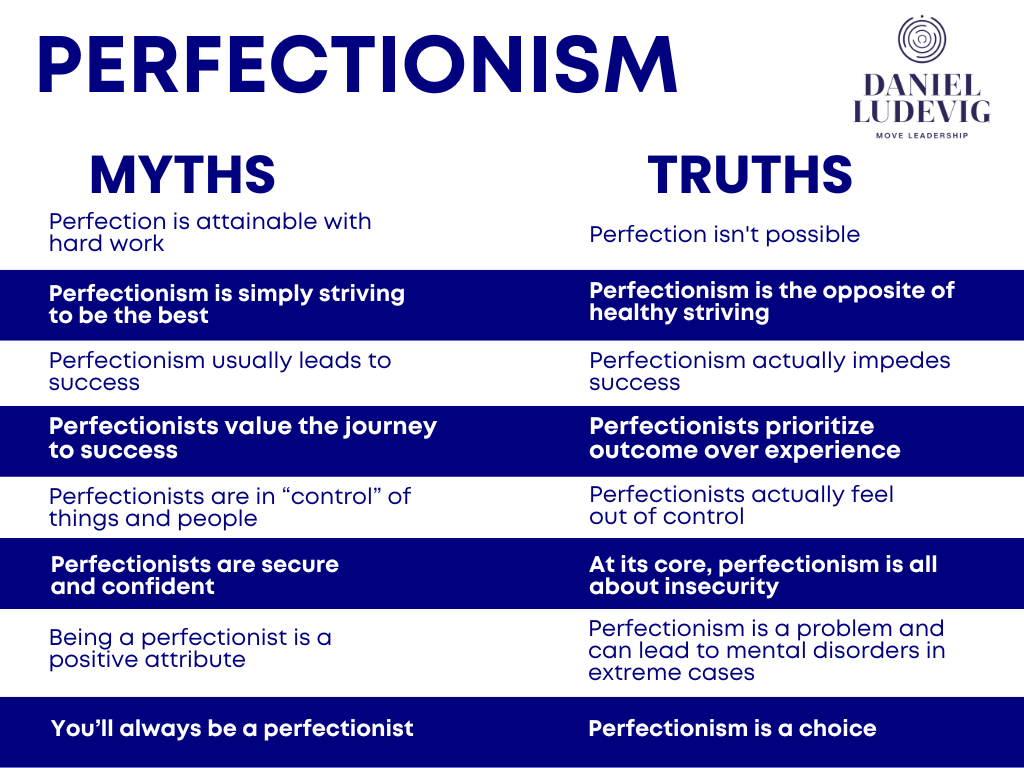
Below is an infographic that highlights some of the key differences between perfectionism myths and truths, as pointed out by Dr. Christina Hibbert, a clinical psychologist: 

So How Is All Of This Landing With You Now?

I know that for me, there's a firework of reactions that go off in my head. The loudest of them is the saboteur voice of perfectionism itself, telling me that this is a load of crap and a justification and rationalisation of anyone's poor performance.

There's also my insecurity saboteur voice telling me that what other people think of me does matter. And there's the armoured ego voice that says I don't have any shame or fears I'm running away from, so hah!

But behind all of those fearful, panicky voices, there's a quieter, more soft-spoken one that also asks to be heard when it questions: 'But what if it's true? What if all my efforts to look, sound and act a certain way have been motivated by a belief that only when I get the approval of others am I actually deserving of being loved and respected?'

And when I listen to this voice, I feel my perfectionism house-of-cards ideology start to crumble. In its absence, rather than emptiness, there is instead a surprisingly powerful feeling of groundedness and calm. The realisation that those external validations are not only fake trophies but even destructive in nature. I notice my attention shifting from being externally focused to internally oriented.

With that shift, there's an awareness that when I drop my objective to be the best in the eyes of others, and rather orient towards being the best I can be, I can both simultaneously believe in "I am enough" while also feeling enormous energy for self-improvement, growth, and achievement. The seeming tension between these two beliefs melts away. I begin to understand that success isn't about measuring up against the expectations and achievements of others; it's about an inner drive to expand my own creativity and resourcefulness and the joy of learning and growing that takes place along the way. And the inner motivation: it actually has the possibility to drive me way further than when I’m '“only” driven to beat others.

This, by the way, links beautifully with Carol Dweck's work on Fixed versus Growth mindsets, which you can read more about in my blog post on that topic. 

So that's where letting go of perfectionism and accepting that "I am enough" takes me. And, of course, it's a work in progress as I navigate just believing in it versus actually implementing it into my daily thoughts and behaviours.

What I'm Really Curious About Is: Where Does All This Take You?

As you simmer in your own thoughts about these differing belief systems, I want to end with some concrete actions (practices and tools) you can use to begin strengthening your confidence in "I am enough" and, with that, build your growth mindset.

Don't worry about doing all of these at once (after all, this is not just another task for your perfectionist self to win at). Rather, view these as various options and choose 1, max 2 of these, and then work on them for a while before revisiting the list and adding some additional ones.

1. Embrace challenges as opportunities for growth

Look at the next few challenges you face as opportunities for learning and growth rather than obstacles to avoid or that determine your worthiness. By embracing them, you can develop resilience and a positive attitude towards situations that stretch and grow you, rather than viewing those situations as threatening your image.

2. Cultivate a curious, learning-oriented approach

Cultivating a love of learning and a curious, open-minded attitude can help you develop a growth mindset. This involves making a habit of seeking out new information, trying new things, and asking questions rather than shying away from what you don’t know a lot about because you’re concerned you’ll look stupid or uninformed.

Look for something you know nearly nothing about (at work, in a conversation with a friend, at home) and get used to how it feels to be a total beginner with loads of questions.

3. Embrace failure as a stepping stone, not a setback

A growth mindset approach involves viewing failures as opportunities to grow and learn rather than as negative outcomes that should have been avoided. This helps foster resilience and perseverance and allows you to approach failures with a positive, constructive attitude rather than seeing them as a blemish on your credibility or ability.

So the next time a mistake or failure happens, catch that inner self-critic, pause it, and instead repeat: 'This failure happened for a reason. It's teaching me something important. What is it?'

4. Surround yourself with supportive and encouraging people

Find people who celebrate you for your effort and not just/only your results. This type of support can help you maintain a healthy mindset, even in the face of challenges and setbacks.

The right support can help boost your confidence, motivate you, and provide you with a sense of belonging. Start noticing what kind of praise you get from whom, and keep those people close who focus on your effort and qualities.

5. Focus more on the process and not just the outcome

Focus on the actions you take, the progress you make, and the lessons you learn along your journey rather than just the final result. Doing so allows you to not only enjoy the experience itself, but you may even find that you end up surpassing your originally set goals or objectives.

Take moments out of the journey to appreciate what you are learning and experiencing along the way that is valuable, regardless of whether you reach your planned destination or not.

6. Seek feedback, and use it constructively

Seeking feedback, rather than seeing it as criticism from others, can help you pinpoint areas for growth and improvement. This type of feedback can help you gain a new perspective on your strengths and weaknesses and refine your skills.

When asking for feedback, try these two questions, which will help improve the quality of what you get in return:

1. What am I doing well?

2. When I do this again, what can I do even better?

7. Reframe limiting beliefs and negative self-talk

Reframing negative thoughts and beliefs that hold you back can help you develop a growth mindset. Identify those perfectionist saboteurs and negative self-talk and replace them with more positive and empowering beliefs and affirmations.

Reading through blogs like these and taking the time to journal about what they mean to you—and then share your thoughts with a friend—is a great practice for this kind of self-awareness.

8. Stay open-minded and receptive to new experiences

Try new things, especially if they are outside of your comfort zone, and embrace new experiences with a positive, open-minded attitude. The more you do this, the greater your tolerance will be for the discomfort that always accompanies doing something new.

Make a list of things that are outside your comfort zone, from small ones (saying hi to strangers) to much bigger ones (signing up for a new course or program). Then choose one a week and do it!

Final Thoughts

Ditch perfectionism and embrace yourself by affirming: "I am enough." By adopting a growth mindset and focusing on progress over perfection, your self-development and life will be happier and more fulfilling. So go ahead, start shifting that mindset, and remember, you've got this! Just being you IS enough.

References:

Brown, B. (2018). Dare to Lead https://brenebrown.com/book/dare-to-lead/

Mindset Health - Growth Mindset vs Fixed Mindset

https://www.mindsethealth.com/matter/growth-vs-fixed-mindset

Dr. Christina Hibbert - Perfect? or Fake?: 8 Myths About Perfectionism & 8 Truths to Cure It https://www.drchristinahibbert.com/perfect-or-fake-8-myths-about-perfectionism-8-truths-to-cure/


Don’t forget to share this blog post with a friend and join my mailing list to stay updated!

Ready to break free from the shackles of perfectionism and unleash your true potential? Follow me on Instagram and LinkedIn today for valuable insights, strategies, and support to help you overcome perfectionism and achieve meaningful progress in your life. Let's embark on this journey of growth together!

How to Start Living Your Full Potential

How to Start Living Your Full Potential

Stop Reaching and Start Digging

You've heard the saying, "Reach for the stars," right? Well, it's time to put that idea to rest. If you want to reach your potential, you need to stop reaching and start digging.

The idea of reaching your potential is not only unhelpful, but it also leads you in the wrong direction in terms of where to look for it. In this blog post, I'll share with you the 5 tools you need to dig deeper into yourself, discover your full potential, and start living it.

But first, let's start by defining what potential is.

What Is Potential?

The technical definition says that potential is "having the skills or qualities to be successful or useful in the future." And when applied more specifically to human development, it's some sense of the greatest version of you that hasn't been realized yet — something in the future, a bigger, better version of you that you have yet to fully embrace and become.

When I hear people talk about potential, it seems to suggest that it is something OUTSIDE of our current selves that we need to become:

  • "It's not here within me."

  • "It's somewhere out there."

  • "Something I need to reach and grab and move towards."

Hence the expression: reaching your potential. For me, that expression leaves somewhat discouraged because it feels far away and like a lot of work. Have you ever felt that way too?

How Do You Reach Your Full Potential?

The truth is that your potential is within you. It's not some faraway place or goal that you need to work towards. It's not something outside of yourself that needs to be reached and grabbed — it is the very essence of who you are. Sure, there might be some learning around new skills or tools that can help, but when we really see someone living their potential, it isn't because of a new skill they mastered. It's because of a shift in mindset to finally step into their full power.

Unlearn Limiting Beliefs & Habits

Often, this mindset shift starts with unlearning limiting beliefs and habits that stand in your way of accessing it. You need to be able to fully believe that the only thing between you and your full potential is YOU. Your willingness to believe this activates the superpowers that are already within you.

Stop Reaching and Start Digging

To reach our full potential, we have to stop reaching and start digging. The magic we are looking for out there is inside us. A good example of this is the miracle of a caterpillar becoming a butterfly.

Caterpillars have a unique method for transformation. Rather than using inspiration from the outside world, they cocoon themselves into a full and deep retreat — and then emerge about 3 weeks later as completely transformed beings who can now fly.

It is by cocooning into ourselves and doing the inner work that we gain direct access to our potential.

Why Am I Not Using My Full Potential?


The Fear of Being Great

Fully believing in our greatness can be scary. Marianne Williamson, an American author and spiritual leader, says: “Our deepest fear is not that we are inadequate. Our deepest fear is that we are powerful beyond measure. It is our light, not our darkness, that most frightens us."

We are scared of believing in our own power because it forces us to take responsibility for using that power and live up to its potential. And even before you can use it, you have to first really accept that it's there and that you are truly enough.

Yes, you really are enough.

Trying to be anything other than who you are is what stops you from really accessing your potential. When you start believing in your own self-worth, it becomes easier to express who you truly are. It’s you being more of you.

And that's what living your potential really is — becoming the truest, kindest, most talented, and most creative version of yourself. It's all already there, but in order to access it, you need to stop reaching and start digging.

So how do you actually do that deep inner digging? There are so many ways, but I'm going to focus on 5 tools that can help you access your true potential and start living it.

How to Reach Your Potential Using 5 Tools


1. Step out of your comfort zone and try new things


This first tool encourages you to leave your comfort zone and try new things. Every new experience you have teaches you something new about yourself. These insights give you hints about your greatness and the talents you may not have known you had. So, try something new (at least once a month) to shake things up and see what happens after you step out of your comfort zone.


2. Shift from a “fixed” to “growth” mindset by focusing on your internal motivators rather than external approval

Find ways to do things not for the end result or how other people will see it but just for the journey of learning about yourself. By doing this, you'll discover sides of yourself that can exist outside the realm of what other people think and accept. Those sides can help you get in touch with your full potential.

You can also connect this to the first tool about trying something new:
When you try new things, quit worrying about how good you are at them and instead focus on the experience itself. You can even take existing activities and tasks you've already been doing for a while and see what happens when you shift your motivation for doing them from external approval to internal curiosity.

3. Embrace challenges to discover your real strengths

Make sure that you aren't only working on things that are easy for you because otherwise:

  • How will you know what your limits are?

  • How will you know what your capabilities really are?

  • If all of your tasks are easy, then how will you ever grow?


Look for things that challenge you because there's no other way to find out what you're made of than when you put yourself through a real test.

4. List down your fears, uncover what really worries you, and push through with courageous acts

  • Take so- Highly unlikely to happen; or

  • Not even that scary in the first place.

In fact, research says more than 90% of the things we worry about never really happen. But even knowing that, our fears can still be very real and feel extremely scary.me time to reflect and write down a list of the things you're afraid of. Ask yourself why those things scare you, and really dig into the worst-case scenarios that you're most afraid of with each of those fears.

Often, that alone can already help you realize that the thing you're most afraid of is either:

So what do you do when that's the case?

Take those remaining fears and think about what you would do if they happened. Visualize how you would handle the situation. Realizing that you can respond to your fears rather than be paralyzed by them diminishes the weight those fears have on you.

And if you want to fully understand what your fears are trying to teach you, then you need to take action and push through. Once you do this, you'll realize that those fears don't have a permanent grip on you. And rebuilding your relationship to fears is one of the most direct ways to accessing your full potential.


5. Surround yourself with people who see more of your potential than you do and benefit from their support in your journey


Fear limits you and your vision. So, surround yourself with people who truly love and care for you and are already relating to your potential. You'll know who they are because being with them brings out your best qualities and makes you feel your best.


Ask them to tell you exactly:

  • What they see in you

  • Your strengths and abilities

Then use that information to build up those qualities and dig deeper into what's keeping you from seeing them in yourself.

Takeaway

To recap, here are the 5 tools you need to step into your greatest future self:

  1. Step out of your comfort zone and try new things.

  2. Shift from a “fixed” to “growth” mindset (by focusing on your internal motivators rather than external approval).

  3. Embrace challenges to discover your real strengths.

  4. List down your fears, uncover what really worries you, and push through with courageous acts.

  5. Surround yourself with people who see more of your potential than you do and benefit from their support in your journey.

I hope these 5 tools will help you discover your potential and tap into it. They are simple but powerful tools that allow you to step into your greatness and live life with more meaning, purpose, and passion. Remember, your full potential lies inside you right now. All you have to do is stop reaching and start digging!

References:

Williamson, M. (1992). A Return to Love. https://marianne.com/a-return-to-love/

LaFreniere LS, Newman MG. (2020). Exposing Worry's Deceit. https://www.ncbi.nlm.nih.gov/pmc/articles/PMC7233480/

Don’t forget to share this blog post with a friend and join my mailing list to stay updated with all things TNB!


Ready to live up to your full potential? Follow me on Instagram and LinkedIn today for empowering content, tips, and guidance to help you unlock your true capabilities and create the life you desire. Let's embark on this journey of self-discovery and growth together!

How to Manifest Your Dreams using 4 steps

How to Manifest Your Dreams using 4 steps

When it comes to manifestation, actions speak louder than wishes. It's easy to say or think, "I want a new job" or "I want a different team." But if you're not taking action, then your wish remains just that: a wish. You won't get what you want until you put in the work to make the change happen. So don't just wish for something — plan and take the necessary steps toward making it happen!

In this blog, I’ll talk about manifestation, 4 steps to make your wishes come true, and why taking action is important.

Let's first define manifestation to then understand why actions speak louder than wishes.

What Is Manifestation?

“Manifesting” is the practice of thinking and believing in aspirational thoughts to make them real. Manifestation is setting your mind on something you want to happen and then making it happen in real life.

If you think it, believe in it and put your attention and intention into making it come true, then there’s a good chance it will or that at least something meaningful will come as a result. Action being the key part here of course.

With that in mind, let's discuss what you specifically need to do to manifest your ideas.

4 Steps to Manifest Your Dreams

Step 1: Be Specific and Imagine It

In order for actions to speak louder than wishes, you need to first formulate those wishes. This means making your intentions as specific as possible and pinpointing exactly what are your hopes, dreams, and goals. It's important that you can really visualize the future you are trying to create.

In order to attract, we need to know what it is that we want to attract. That's why the foundational step to manifestation is knowing first what you actually want. Only then can you use all the powers available to you to create those outcomes.

Take some time to imagine yourself in that future:

  • How would you feel?

  • What would you be thinking?

  • Where would you be?

  • Who else would be with you?

  • What challenges would you be faced with?

  • How would you overcome them?

Did you know that visualizing for even a few minutes a day activates the same parts of your brain that would light up if you were actually doing the things you are visualizing?

By starting to THINK it, you are starting to BE it.

And by visualizing not just the wish but also the path towards it (including how you will overcome inevitable obstacles you will encounter along the way), you set yourself up to tread the long road to your dreams.

So once you have a clear, specific intention and you can really see it, how do you then pair action with that? Well, since actions speak louder than wishes, you've got to make sure you’re using the right action.

Step 2: Take Small Actions and Look Out for Chances

Set aside a bit of time each day to think about the specific steps you can take to reach your goals, then build them into your daily routine.

Remember, manifestation isn't about getting favors from the universe. It's about being so clear and focused with your attention that you notice every small thing around you that can help you get closer to your vision.

  • Who do you need to talk to?

  • Where do you need to be?

  • What opportunities do you need to jump on?

Make this a part of your daily schedule. As the expression says, "Where attention goes, energy flows. And where energy flows, life grows.”

This is such an important mindset because the future you want to create is already here right now. You just need to start noticing the small signs and hints that are present all around you.

This means shifting your attention from where it currently is to where it needs to be. Specifically:

  • See the day with fresh eyes;

  • Keep your ears open; and

  • Jump on every little conversation or passing comment as the potential ticket to your future gold mine.

There are billions of possibilities around us all the time, and your job as a full-time manifestor is to tune your antenna to pick up and notice exactly the ones you most need right now. And once you pick up on it, do something about it. That's how you embody the truth behind actions speak louder than wishes.

Step 3: Stay Positive

Actions speak louder than wishes is also about your positivity mindset. There are a number of ways your attitude around manifestation will help turn dreams into reality:

  • Remove Obstacles - Staying positive means removing any obstacles or limits that may cloud your vision and/or block you from sensing what's around you. This includes noticing and suspending fear and negative self-talk.

  • Relentlessly Believe - The quote, “In order to manifest it, you must believe in its inevitability,” really captures the confidence required in manifestation.

  • Reduce Time with Toxic People - You will also want to reduce your time with any toxic people who tell you you can't reach your goals or drain your energy as you try to work towards them.

  • Be Grateful for What You Have - Remember to have gratitude and write down a few things you're grateful for each day. This is not just an appreciation exercise. It actually trains your brain to see more positive things happening each day, which is critical for keeping the momentum and motivation to push forward.

After you've put into place the first 3 steps on vision, actions, and positivity, there's one last ingredient to prepare for.

Step 4: Ride the Swing to Get Unstuck

While experiencing how actions speak louder than wishes, you will get in and out of contact with an emotion called motivation. When you're experiencing it, motivation is so powerful. However, it is also an emotion that comes and goes. And when it goes, we can be left feeling exhausted, uninspired, and hopeless.

Motivation is an exciting energy we feel at the start of something new. It's that natural high that is often externally sourced. When we are benefiting from the drive of motivation, it's called the first swing.

So once it disappears, we need something else to keep us going. And that something is a completely different type of energy, which, if accessed, can initiate a second swing of productivity and progress.

The energy of the second swing is one of structure. This difference between the initial energy of something new and the structured energy that will keep us going is called the model of 2 swings (for more about this, see my separate blog post called ("How to Deal with Motivation Swings").

Between the two swings is an energy dip, and most people quit here and return to something else that is still in its first swing. The commitment to keep going requires structure and a new kind of discipline.

So once you understand the inevitability of the dip in between the two swings, all that's left is to push through that dip and use structure and discipline to get into that second swing of energy. You can even prepare yourself for it in advance by deciding already what you will do once your energy drops and how you'll access that second swing.

You'll know and feel it once you get there. You might even find that the new kind of energy that you'll gain access to is even more reliable and steadfast than motivation.

This is really where actions speak louder than wishes.

Takeaway

Turn your dreams into reality by understanding that actions speak louder than wishes. Don't just daydream — start taking action!

To recap, here are the 4 steps to turning your dreams into reality:

1) Be specific and imagine it;
2) Take small actions and look out for chances;
3) Stay positive; and
4) Ride the swing to get unstuck.

Make sure you've got the right structure in place to support you and that you're doing your part by putting in the hard work and reflection needed to get out of the dip and into the next swing.

I hope this post has been helpful, and I wish you all the best in turning your dreams into reality! Good luck as you manifest by letting your actions speak louder than wishes.

Ways to deal with Criticism and Judgment

Ways to deal with Criticism and Judgment

Use people's judgments as your daily mirror.

You've probably heard that criticism is a good thing — that it can help you grow and improve. But sometimes, hearing someone say something as simple as, "You did a bad job" or "You're not doing that right," or "You should have done this instead!" can hurt. In fact, it can be downright awful!

But here's the thing: criticism only hurts if we let it. If we learn how to handle our reaction to judgment and criticism from others we'll be able to stay focused on how to actually benefit from it rather than it bringing us down. Use people's judgments as your daily mirror.

In this blog, I'll share ways to deal with criticism and judgment that others throw our way, allowing you to stay positive, focused, and still able to grow.

Responding to Judgment

Before you can use people's judgments as a daily mirror, you first need to understand how judgment works. When someone judges you for something, and their comments don't bother you, it is because of the confidence you have already built for yourself around that topic.

Think about something you are proud of and know you are good at. Or something you have already worked through any issues yourself.

If someone is critical about it, most of the time, it's easy to let the comment just run off of you like water. But when someone judges us and their judgments sting us, it's actually an indication that their judgement is triggering a reaction in us that could benefit from deeper examination from our side.

And in these cases, we have two options for how to react: let the judgment bring us down or face it head-on and use people's judgments as our daily mirror.

1) Let Judgment Bring Us Down

Taking someone else's words to heart, letting them define who we are, bursting out with anger, or feeling bad about ourselves can have harmful effects on our mental and emotional health and even our physical health.

Feeling this way over a prolonged time can cause depression, anxiety, and a lack of motivation. And when we judge ourselves for not being good enough, it's hard to see the good in ourselves or others.

That said, it's quite natural to have a tendency to notice and hold onto negative criticism. In fact, negative emotions are more strongly felt and remembered in greater detail than positive ones, according to American social psychologist Roy Baumeister. They are also a natural part of being human. If used wisely, these emotions can even act as signposts that help us to take healthy action, like setting boundaries, or standing up for ourselves, or speaking up. But when we let the emotions completely consume us, we lose the ability to benefit from them and only suffer in their presence.

Baumeister summarizes academic studies in his research paper titled "Bad Is Stronger Than Good", showing how the brain more likely remembers negative criticism than praise. He says that for every negative event, five positive ones are needed to make up for it.


2) Face It Head-on

When we face judgment head-on, we're able to use it as a tool for learning and growth. We also feel empowered! We understand that our value lies within ourselves and not in what other people think about us, and we can use that understanding to grow as people.

I'm not saying this is easy — in fact, it can often be super hard — but if you learn to approach others' judgment with curiosity about your own reaction to it, you'll find there's so much waiting to be discovered.

So what's a positive way to face it head-on and deal with Negative Criticism?

Use people's judgments as your daily mirror.

Rather than working ourselves up over negative criticism, let's use other people's judgment as a gift. If we can learn to accept and use criticism as an opportunity for growth, we'll be well on our way to becoming more confident, self-loving people who make decisions from a place of integrity rather than fear.

It's a gift to look into the mirror and ask ourselves:

  • Why do I care so much about this?

  • What part of me is feeling the same way?

  • What do I want to do about it?

Through these questions, lean in with curiosity toward your reaction to the criticism. The focus here is less on the criticism itself and more on what it's doing to you.

As mentioned before, if you have no reaction, then the topic is one you've probably already worked through, so it doesn't trigger you. But if you do have a reaction, then it's either because you agree with the criticism (even if you deny it) or you have some unsettled business with it that is still worth exploring.

Then:

- If deep down, you AGREE with the judgment, start by acknowledging you have some work to do on the issue.

- If you DISAGREE with it, then you have some work to do on feeling more secure about the way you are or why you're doing whatever it is that you're doing. Something about this criticism is forcing you to look at an aspect you don't like or haven't worked through yet, so it's time to get cracking!

Either way, progress comes from deciding to use people's judgments as your daily mirror. Does this mean that once you’ve worked through your reaction to it you’ll never get triggered by that criticism or judgement again? No! We are all human after all and it’s completely normal to be triggered, reactive and emotional when other people’s comments leave us feeling unsafe. But while the trigger itself may not entirely disappear, what you do have control over is how long you stay triggered, and what you then decide to do with your reaction. And that is something that working through the above series of reflections can really help with.

Takeaway:

Remember, the only way to truly handle criticism is to be aware of it and know how to make it work for us. The key is not to let the judgment of others get in our way. We can't control what other people think, after all.

When we're criticized, instead of getting defensive, use people's judgments as your daily mirror and ask: "What can I learn from this?" You might be surprised at what you find!

References:

Baumeister, R. F., et al. (2001). Bad is Stronger than Good. https://www.researchgate.net/publication/46608952_Bad_Is_Stronger_than_Good

How to Deal with Motivation Swings - Get unstuck and back on track

How to Deal with Motivation Swings - Get unstuck and back on track

Ride the Swing to Get Unstuck

Ever felt like your motivation is all over the place? Like sometimes you're super pumped and motivated to work on your goal, and other times you just can't get yourself to do anything?

Well, I have good news for you. You're not alone. This happens to everyone. And it's totally normal!

In this blog post, I'll help you understand what's going on with your motivation and how it works in 3 swings. Once you understand the difference between each swing, you'll know how to deal with those energy dips and get back on track. In other words, you'll know how to ride the swing to get unstuck!

Concept of 2 Swings and Safe Space

Motivation is an exciting energy we feel at the start of something new. It's the natural high and drives that are often externally initiated (we love the new project, or boss, or program...). Like any emotion--and feeling motivated is an emotion--it comes and goes. So once it disappears, we need something different to keep us going. And that something is a completely different type of energy. The energy of structure. This difference between the initial energy we experience when doing something new versus what will sustain us in the long run is sometimes called "2 swings."

The concept of 2 swings is a useful way to understand how we experience motivation. It also helps us make sense of why our energy and focus often vary over time. Once you understand the difference, you’ll know how to ride the swing to get unstuck!


Let’s look at how this concept can help you understand and manage your energy.

The 1st Swing - Motivation, Inspiration, and Excitement

We often feel a burst of enthusiasm and energy when we start something exciting and new. But as time passes, that initial excitement typically wears off. We realize that to really implement a new skill or improve it requires more effort than we had anticipated.

While we may have been improving at first, now we are plateauing. We return back to our day-to-day and feel that we can't integrate the new habit, even though we know that we should. And along the way, we become tired or distracted by other things. In fact, maybe we even jump to other activities that are still in their 1st swing; those activities give us that motivation, inspiration, and excitement that we are currently lacking and yearning for. It's a distraction but it feels good!

This is when the real test when learning something new happens — when it gets hard rather than fun. And that's where most people quit. They quit at the dip. It's called the dip between the 2 swings because that's where our energy drops to its lowest point. But if you plan for the dip and adjust yourself accordingly, a 2nd swing kicks in.

The 2nd Swing - Structure, Routine, Discipline, and Reflection

The energy and focus we need to get into the 1st swing are not the same as what we need to get into the 2nd swing. That's because while in the 1st swing we temporarily stepped out of our comfort zone (and felt some exhilaration from doing so), the 2nd swing actually requires us to grow and stretch our comfort zone to a bigger size. The 2nd swing is where we start to integrate the "new" into our habits and daily behavior. It's about being uncomfortable and pushing through anyway.

By starting to make this new habit into a normal one, the 2nd swing is when we start to see real progress. But in order to stick to it, we structures that enforce our discipline and keep us focused. We need to build our own ways of daily practice.

One way to do this is by building in practice time of the new habit around existing routines. Take something you already do every day--like brushing your teeth or walking to work--and build in time to practice your new habit just before or just after it.

By pairing your new behavior with an existing one, you make it easier for yourself to remember to practice that new habit. And soon enough, it will become easier to do altogether. That's when your comfort zone starts stretching and growing larger. When that happens, the new habit stops feeling as uncomfortable as it previously did and becomes part of your conscious abilities. That's how you ride the swing to get unstuck!

And while doing all of this, build in a few moments here and there to pause, reflect on your process, and see what needs to be changed or modified to keep up the good work. Reflection is key to making sure you are actually staying on track with your initial goal and not slipping sideways.

The Safe Space

During the 1st and especially 2nd swings, it's common to jump into judgment or self-criticism. You hoped this would be easier than it turned out to be. Or you thought you'd be better at this new skill and be able to see the impact faster.

Remember to be kind to yourself. This transition from 1st to 2nd swing requires support, love, and patience, so don't jump to conclusions too fast. Give yourself the time to practice, experiment, and even fail. Mistakes are your stepping stones towards success. Protect the safe space in which to make those mistakes and learn from them.

The 3rd Swing

If you get through the 2nd swing, then you're well on your way towards the 3rd, where:

  • The learning actually becomes integrated;

  • Our comfort zone expands fully; and

  • We can finally get the full benefit of the experience.

The 3rd swing is where we can start to reap all the fruits of our labor and enjoy a real sense of accomplishment.

In the 3rd swing, you start to look at how to maintain this new habit in the long run. Ask yourself, what are you going to do every 3-6 months to make sure to keep your new skills sharp and ready? This is also where the celebration is so important, as it triggers the brain's positive reinforcement mechanism by releasing those feel-good hormones that make you want to succeed even more. Be grateful for what you've accomplished and any support you've had along the way.

The graphic below shows how our energy works in 2 swings with a safe space for growth, learning, and appreciation, and 3rd swing coming right after that:

Takeaway

Ride the swing to get unstuck!

Learning to deal with energy swings is an important part of the process of building a healthy, fulfilling life. Understanding the concept of fluctuating motivation can help us to get unstuck and back on track.

So the next time you feel unmotivated or stuck in a cycle of unproductive behavior, try taking a step back to reflect on what’s happening behind the scenes. Where are you in the journey of 2 swings, and what energy do you need now to keep going? Then use that information to make changes in your environment or approach to help you get back on track with your goals.

References

Transformation Architects - Culture Transformation: “Two Swings & Safe Space!”

How to Cope with Burnout – the Psychology Behind it, What It Means, and Different Stages

How to Cope with Burnout – the Psychology Behind it, What It Means, and Different Stages

Burnout is a serious issue. It’s not just an annoyance or temporary state of mind but rather a serious problem that can have lasting effects on our health and well-being. The past few years of lockdown and pandemic have only made more visible the real pandemic of our times: our deteriorating mental health.

When we experience burnout, it’s important to take steps to recover from it as quickly as possible — before the situation gets worse. In this blog post, I’ll discuss the psychology of burnout and its different stages. I’ll also cover some ways to cope with burnout should you or someone you know experience it.

What Is Burnout?

Burnout can be defined as a psychological condition that occurs when we feel exhausted or drained of our mental resources. When we experience burnout, it’s likely because we’ve been pushing ourselves beyond our limits and have started to feel mentally and physically exhausted.

Burnout is often experienced by people with jobs requiring them to work long hours, but it can also happen if we push ourselves too hard in any area of our life — school, work, or home. When the tasks required of us exceed the amount of time that we have to complete them, we can feel totally overwhelmed. Feeling overwhelmed for extended periods of time often leads to burnout.

This happens when we are asked to perform at high levels for extended periods of time without being given adequate support or recognition for how to meet these expectations.

For example, we might find ourselves feeling burnt out if:

  • Our boss expects more from us than what is reasonable based on what they know about our skillset (or lack thereof);

  • We take on extra projects at work without being rewarded financially or with more freedom/flexible hours; or

  • We are so focused on building our businesses that we neglect our health, relationships, and leisure activities. This can lead to loneliness, depression and isolation, which further compounds the problem since it can get harder to get back on track with our goals.

Burnout vs. Other Types of Exhaustion and Stress

As mentioned earlier, burnout is a psychological condition that can be described as a combination of exhaustion and apathy. Unlike stress, burnout is not a temporary state of feeling overwhelmed. Instead, it's an ongoing battle with chronic exhaustion and lack of motivation that can last for months or even years.

In addition to these symptoms, people experiencing burnout often report feelings of depression and anxiety, including feelings that they don't enjoy life anymore or feel like they have no purpose in life. And this makes sense when you think about how much energy goes into just getting out of bed every day — not to mention having the energy to do anything else once you're up!

This leads to another important point: although many people use "burnt out" as shorthand for being tired or exhausted (which isn't necessarily bad), the two terms aren't interchangeable.

Burnout specifically refers to a psychological condition where we feel drained physically, mentally, and emotionally all the time. It’s a feeling that doesn't necessarily come from overwork alone but often occurs alongside physical exhaustion as well. In other words, high stress levels over a long period of time often lead to exhaustion and, therefore, BURNOUT.

Stages and Signs of Burnout

Burnout is a gradual process that can develop over months and years, and the symptoms vary from person to person.

Herbert Freudenberger, a German-born American psychologist, is credited for introducing the concept of "burnout" in the 1970s. He used the term to describe the effects of severe stress and high ideals. Freudenberger also defined how burnout typically develops through a  12-stage model:

Stage 1: Excessive Ambition
We feel a strong need to prove ourselves.

Stage 2: Working Harder
We keep working harder and become addicted to our work.

Stage 3: Neglecting Our Needs
We start to neglect our needs and focus solely on our goals.

Stage 4: Conflicts & Needs Displacement
We become overwhelmed by stress, which eventually makes us feel like a failure and blame others for our situation.

Stage 5: No Time for Non-Work-Related Needs
Our values change as we shift to focusing more on our work.

Stage 6: In Denial of Our Problems
We deny emerging problems due to work stress.

Stage 7: Withdrawal & Cynicism
We withdraw from our social life, friends, and family. In this stage, we also develop bad habits (e.g., alcohol or drug use) to relieve stress.

Stage 8: Behavioral & Psychological Changes
Our behavior changes, and it upsets those around us.

Stage 9: Depersonalization
In this stage, depersonalization occurs, wherein we no longer feel like ourselves.

Stage 10: Inner Emptiness & Addictive Behavior
We feel numb and empty. In this stage, we seek activities like sex, substance abuse, or binge eating to fill the void.

Stage 11: Meaninglessness & Lack of Interest
We feel lost, depressed, and totally exhausted.

Stage 12: Life-threatening Physical & Mental Exhaustion
This is the burnout syndrome. We physically and mentally break down and become completely overwhelmed.

During these stages, several signs may signal us that burnout is happening:

  • Lack of energy, feeling exhausted, completely drained, and losing interest in doing things;

  • Experiencing physical symptoms, such as feeling numb and recurring headaches, particularly in response to work stress;

  • Performance issues and developing a negative attitude towards our job and colleagues; and

  • Unable to cope with life while having negative thoughts about accomplishing things.

Coping with Burnout

Burnout prevention is a far easier approach than trying to recover from a full 12-stage burnout. People who get to that point are entirely unable to function, and the path of healing is a slow and lengthy process. However, regardless of where we are in the burnout model, the following coping techniques can help:

How to Cope Physically:

  • Get enough fresh air and exercise regularly.

  • Get enough sleep to allow your mind and body to recharge and heal.

  • Take care of your health by eating a balanced diet and avoiding alcohol.

How to Cope Emotionally:

  • Set boundaries clearly.

  • Think about what’s most important, then write them down.

  • Calm your thoughts and relax your body by practicing mindfulness.

  • Take on creative pursuits to keep your minds active and your attention diverted.

How to Cope Socially:

  • Talk about your problems with people close to you and ask for help.

  • Make friends with colleagues to feel less isolated.

  • Stay away from individuals who give off a negative vibe.

How to Cope Professionally:

  • Work-related coping methods include taking a break from work or changing careers (if possible).

  • Try to find meaning in you work or things you enjoy doing.

  • Prioritise tasks to create a better work-life balance.

Takeaway

Burnout is a serious issue. It can be an incredibly stressful and exhausting experience. If you have been feeling this way for a while and don't know what to do about it, I hope this blog post has helped you understand what burnout is and how you can cope with it. Please reach out for help if you need it. You are not alone and there is lots of support out there.

References:

Ponocny-Seliger, Elisabeth & Winker, R.. (2014). 12-phase burnout screening development, implementation and test theoretical analysis of a burnout screening based on the 12-phase model of Herbert Freudenberger and Gail North. ASU International. 49. 927-935. 10.17147/ASUI.2014-12-11-01.

De Hert, Stefan. “Burnout in Healthcare Workers: Prevalence, Impact and Preventative Strategies.” Local and regional anesthesia vol. 13 171-183. 28 Oct. 2020, doi:10.2147/LRA.S240564

Kaschka WP, Korczak D, Broich K. Burnout: a fashionable diagnosis. Dtsch Arztebl Int. 2011 Nov;108(46):781-7. doi: 10.3238/arztebl.2011.0781. Epub 2011 Nov 18. PMID: 22163259; PMCID: PMC3230825.

How to feel Energy and Performance in everything you do

How to feel Energy and Performance in everything you do

When was the last time you stepped out of your comfort zone? Like really did something that made you uncomfortable... I know it's a question that probably doesn't come up very often. But when you think about it, it's actually pretty important.

Why? Because we all have a comfort zone. It's what keeps us safe and secure but also makes us feel stuck or bored. And because we're human, we tend to stay in our comfort zones for as long as we can (our brains and bodies are always looking to try to simplify and secure us). That's why we need to force ourselves to step out of our comfort zones. By doing so, we get access to the amazing world of experimentation, personal development, and stretching our abilities.

But if you leave your comfort zone, where does that mean you end up? Ask yourself:

  • Are you in your comfort zone?

  • The good zone? OR

  • In the terror zone?

Maybe you've never thought about these zones before. But now that you have, wouldn't it be nice to know where you are (and how to get to where you should be)?

For starters, let’s define the comfort zone and discuss 2 other psychological states related to it: the good zone and the terror zone.

Comfort Zone – What is it exactly?

The comfort zone is where we feel safe and secure. It's our home, our cozy bed at night, or the path we take every day to work or school. It’s the work projects we could do in our sleep and the skills we acquired ages ago. We're comfortable there because we know what to expect. We know what will happen next, and so do all the people around us who share this space with us.

It's also where we do things repeatedly, which is why people sometimes call it "routine" or "habit." Routine can be a good thing if it means that we’re doing things right. But in many cases, routine isn't helping us move forward. Instead, it's holding us back from discovering new things about ourselves and maybe even changing for the better. It's keeping us the same as we were yesterday and the day before that.

What Is the Good Zone?

The good zone is the right balance between pressure (from outside forces like deadlines), stress (from inside forces like an overcrowded mind), and performance (what we actually produce).

It's about pushing ourselves to take on new challenges and grow, but not so far that we’re overwhelmed or unable to handle the situation. It's about being able to handle stressful situations without getting mentally bogged down by them.

The good zone is where we must consciously decide to try or do something differently, but we are still able to handle the pressure and stress that comes with it.

Now What About the Terror Zone?

When stress becomes too much to handle, it's easy to fall into the terror zone. The terror zone is the opposite of the comfort zone. It's where we face discomfort, uncertainty, and risk. This zone is the place where we can't do anything right, and it's also the place where we are most likely to give up. It's a state that is characterized by panic, rage, and fear. Prolonged time in the terror zone leads to chronic fatigue, physical illness, and burnout.

So now that you know what they are, which one have you been in today, this week, and this past month?

Knowing Our Boundaries

  • It's important to be aware of what our boundaries are and where they lie:

  • If we’re in the COMFORT ZONE, we’ll know it because we will feel familiar and safe.

  • If we’re in the TERROR ZONE, we’ll know it because we feel overwhelmed, confused, and helpless.

  • The trick is finding our GOOD ZONE — the place where we can be challenged but not overwhelmed and feel safe but not stuck. Here we are driven, motivated, energized, and inspired.

The Good Zone Is Where We Want to Be

It's where we feel like we’re doing things right and being productive, and it's also where we can do most of the things that are important to us. But how do we get into this magical place? And what does it look like once we're there?

If we are spending too much time in the comfort zone, then moving to the good zone is about getting comfortable with being uncomfortable for a little while. What this looks like will be different for everyone, but some examples include:

  • Taking on a new challenge at work;

  • Learning a new skill; or

  • Trying something for the first time.

Alternatively, if you are in the terror zone moving to the good zone is about learning to let go, putting up boundaries, and being able to say no. This can include:

  • Delegating some project work to a colleague;

  • Speaking to your boss about your priorities and what to let go of; and


Spending time with friends, family, or loved ones after a long day to decompress and get outside perspective.

Here are a few key things I do to stay in the good zone:


1. I set realistic goals.

Trying to accomplish too much in a short period will only lead to frustration and disappointment. I start small and work my way up. I say no to things that take me out of my focus and make sure I'm prioritizing my time carefully.

2. I take care of myself physically and mentally.

Eating right, getting enough sleep, and exercising are all important factors in staying productive. If my body isn't feeling good, it will be harder to focus on what I need to do.

3. I find an activity or project that makes me happy and stick with it.

Doing something I enjoy outside of work helps reduce my stress levels and makes it easier for me to stay motivated. I create clear stopping times at the end of each day when I end work and start unwinding.

These three techniques have helped me stay on track, get things done, and find the balance between my comfort zone and terror zone.


So here are some final thoughts:

If you want to achieve more and feel better, you need to spend more time in the good zone. That’s it! It’s just not enough to only step into the good zone once every month or so. You need to be there as often as possible because that is how you grow as a person — by stretching yourself, trying new things, and taking risks.

Whatever you want to do in life, the important thing is to pursue something different from usual, which pushes past those old boundaries of your comfort zone into this new territory where growth awaits you. And if you're in that terror zone, you have to start scaling back before it's too late.

Give these techniques a try, and let me know how it goes!

How to say NO and feel good about it

How to say NO and feel good about it

We don't like disappointing people. We tend to say yes when we'd rather say no. When we say yes, we feel resentful, unappreciated, and burdened. I bet you have wondered one time or another, "How do I say "NO" and feel good about it?"

I have a confession to make — I don't like saying no. It's a terrible struggle for me. But time is limited, and if I'm not careful, I end up missing out on all kinds of awesome opportunities. It's hard to say no, but it’s a lesson that has to be learned. Let me share with you a few tips for getting over your guilt and saying no with confidence:

Make Your Life a Top Priority


It can be too easy to get caught up in everyone else's needs. You may find yourself saying yes when you really want to say no. It's important that you make your own life a top priority. So, if you're going to say yes, it should be for a very good reason and connected to something that is truly important to you.

Know What You Want and Need


It can be hard to say no when someone asks for something, especially if you don't know what it is that you yourself want or need. Take time to determine what your priorities are and make sure you have room in your schedule for the things that are most important to you. It may help to write down everything that's filling your schedule so that you can better see what needs to be added or removed. Remember that if you are not taking care of your own needs, it will be near to impossible to sustainably take care of others when you want to help them.

Think Through the Consequences


Think through the consequences of saying yes or no. If it's something that will take a lot of time, money, energy, or effort, it's probably not the best use of your resources unless it's something that truly matters to you in the long-run.

Don't Explain Yourself


"No" is a complete sentence, and it's a powerful one! The problem is that many of us find the word difficult to say, or at least difficult to say without feeling guilty. We feel like if we say no once, we'll have to say it for everything. We fear that saying no will damage our relationship with the person who's asking for a favor or that it will change how they think about us. Other people also worry that saying no will hurt their careers or make them look bad. These hesitations to say no all come from a place of fear and won't actually help us get what we want or feel good about ourselves. Here are a few of my favorite self-explanatory ways to say No:

Cut the Guilt Trip


Do not feel bad about standing up for yourself! If someone tries to guilt you into doing something, ignore them or just repeat yourself until they stop arguing with you. Remember that you are not responsible for other people's reactions, but you do have control over how you choose to respond to and feel about them.

So what's the main takeaway here? Saying no can be difficult, but it will help you get your life in order. Remember, learning to say no is an important life skill, which can also be a good thing for your health and well-being! Here’s how you can effectively do it:

  1. Just say it. Don’t beat around the busy, make lame excuses or hem and haw.

    Example: “That sounds great, but I’m already committed.”

  2. Be assertive and courteous. This is a technique that puts you in a position of power by shifting the dynamic and timeline.

    Example: “I appreciate the invitation. I’ll have to take a rain check for another time.”

  3. Set boundaries for yourself. People have a difficult time saying no because they haven’t taken theme to assess their own boundaries and decide in advance where they stand.

    Example: “I am going to say NO for now. I’ll let you know if something changes.”

  4. Be firm. Stand firm and don’t feel obligated to cave simply because the other person is upset.

    Example: “I am not comfortable with that. It would be best for me not to join/attend/participate.”

  5. Put the question back on the person asking.

    Example: “I’m glad to work on A, B, and C; but to do a decent job I’d need 3 weeks rather than 2. How would you like me to prioritise completing these tasks?”

Let me know which of these NO’s works best for you!