

When Smart People Get Stuck
Do you recognize this situation:
You’re sitting in a meeting with capable, experienced people.
Everyone is engaged. Everyone has a perspective.
And yet something isn’t working.
The conversation moves, but not forward.
People argue about solutions before agreeing on the problem.
Some push for quick answers, others say it’s more complex.
And by the end, there’s either no decision or a decision no one fully stands behind.
It doesn’t feel like a capability issue.
It feels like something deeper.
The Hidden Challenge: We Misunderstand the Situation
What’s often missing is not intelligence, effort, or even alignment.
It’s clarity about what kind of situation we are actually in.
Because most leadership challenges today are not problems we can simply analyse and solve.
They are situations where:
Cause and effect are unclear
Multiple perspectives can be true at the same time
The right answer depends on how we interpret what’s happening
In other words, complexity and unpredictable.
And yet most organizations are still wired for a predictable world where they believe they can control their outcomes.
The Leadership Skill That Matters Most
The ability to think clearly in a world that is not.
Not by forcing clarity.
But by:
Understanding the situation you are in
Adapting your thinking to it
Creating space for better decisions to emerge
This starts with two foundational shifts:
Diagnosing the situation correctly
Recognizing the mental traps we fall into when facing complexity
Framework 1: Understand the Situation
Before solving anything, you need to understand what you are dealing with.
Because not all problems are the same.
The Core Distinction: Predictable vs. Unpredictable
Dave Snowden created the Cynefin model to help navigate complexity by helping you answer one question:
What kind of world am I in right now?
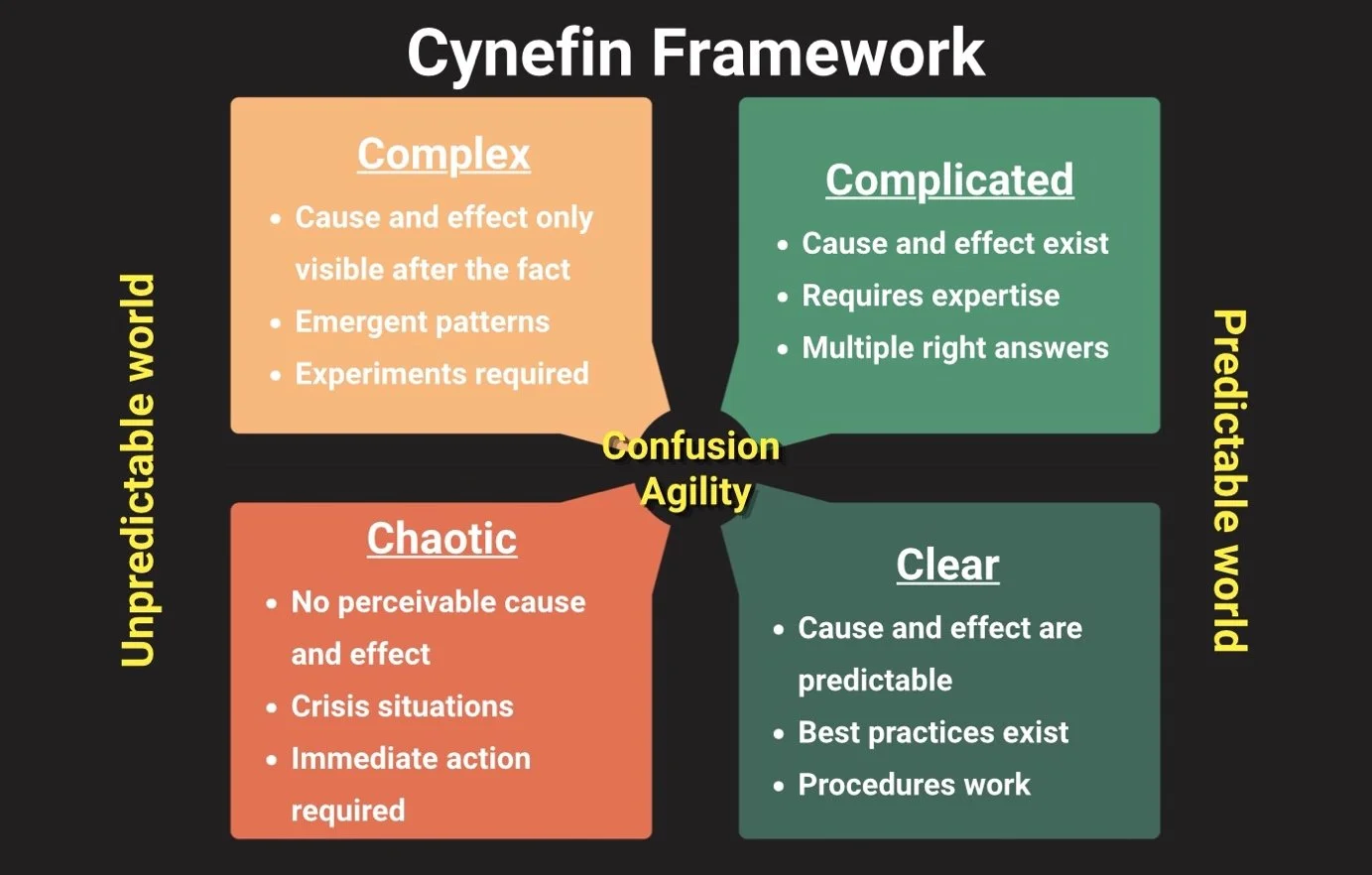
The Predictable World
- Clear
Cause and effect are obvious
The solution is known
Processes are repeatable
Example: payroll, compliance, routine operations
Approach: Follow best practices and execute reliably.
- Complicated
Cause and effect exist
Expertise is required
Multiple right answers are possible
Example: engineering challenges, financial modelling
Approach: Analyse, decide, implement. This is where experts are really useful to have onboard.
The Unpredictable World
- Complex
Cause and effect are only visible afterwards
Outcomes emerge over time
No clear right answer upfront
Examples:
Culture change
Innovation
Leadership transformation
Approach:
Experiment, observe, adapt. This is where expertise often gets in the way. Analyzing won’t get you to a solution and past experience often isn’t helpful either.
- Chaotic
No clear cause and effect
High urgency
Immediate action required
Example: crises, system breakdowns
Approach:
Act first, stabilise, then understand
The Critical Mistake
Most organizations are built for complicated problems.
But many leadership challenges today are complex.
So leaders:
Analyse when they should experiment
Build detailed plans where learning is required
Expect certainty where none exists
The result is slow decisions, frustration, and misalignment.
Misunderstanding (or misdiagnosing) the actual situation (as predictable or unpredictable) you are currently facing is the fundamental first step to navigating your challenges well. If you get that wrong, everything you do and decide on afterwards will either fail or cost you a massive waste of time.
Framework 2: Why Thinking Breaks (The Mind Traps)
Even when we are in complexity, our thinking does not stay there.
It simplifies.
Why This Happens
Because our brains evolved to deal with uncertainty quickly, not deeply.
“Our nervous systems evolved to help us make quick decisions under pressure, not to analyze complex situations.”
According to Jennifer Garvey Berger and her work on Leadership Mindtraps, these shortcuts help us act fast, but they limit how we think.
The 5 Mind Traps
Here is a quick overview of the five mind traps, with examples of how they might show up in complex situations and small tools that can help you shift back to more openness and curiosity.
1. Simple Stories
We reduce complexity to one explanation.
“Sales are down because marketing failed.”
In reality, multiple factors are interacting.
Shift:
Ask what might be missing and what other explanations exist.
2. Rightness
We focus on being right instead of learning.
Conversations turn into debates.
Shift:
Ask what you might be wrong about and what others see that you do not.
3. Agreement
We avoid tension to maintain harmony.
Meetings feel smooth but lack depth.
Shift:
Explicitly invite different perspectives and make disagreement safe.
4. Control
We try to force certainty.
Detailed plans in uncertain environments.
Shift:
Ask what is safe enough to try (80% good enough) and what small experiment could generate learning.
5. Ego
We defend who we are.
“I’ve been doing this for 20 years.”
The conversation becomes about protecting identity instead of exploring ideas.
Shift:
Ask what could be learned if you stepped back from being an expert.
What This Creates
These mind traps narrow thinking.
They make complex situations feel simple and predictable.
And they keep teams stuck in the wrong approach.
When I speak with my clients these days, they all agree that the majority of problems they are facing are complex ones. Yet their meetings, structures, and decision-making are still operating as if those challenges as complicated and predictable. Learning how to assess the reality of the situation we are facing and then be able to catch the behaviors that keep us from confronting it honestly are the real and necessary skill sets of leaders worth following.
Key Takeaways
- Clarity in thinking drives better decisions in uncertainty.
- Not all problems are the same. Diagnose before you decide.
- Treat complex situations with experimentation, not analysis.
- Your thinking shapes the outcome more than the situation.
- Mind traps narrow your perspective without you noticing.
- Curiosity beats being right in complex environments.
-
If you remember one thing, remember this:
Clarity doesn’t come from having the answer. It comes from understanding the situation.